An estate agent's website sits at the top of the funnel for nearly every type of lead: buyers researching properties, vendors comparing agents before requesting a valuation, tenants looking for rentals, landlords evaluating management options. And yet most agency websites convert a fraction of that traffic into actual enquiries.
The problem isn't usually design. Agency websites have improved dramatically over the last decade. The problem is that converting website visitors into enquiries requires more than attractive photos and a contact page, it requires specific mechanics that most sites either lack entirely or implement poorly. The best-converting sites pair good design with AI lead qualification that handles enquiries in real time.
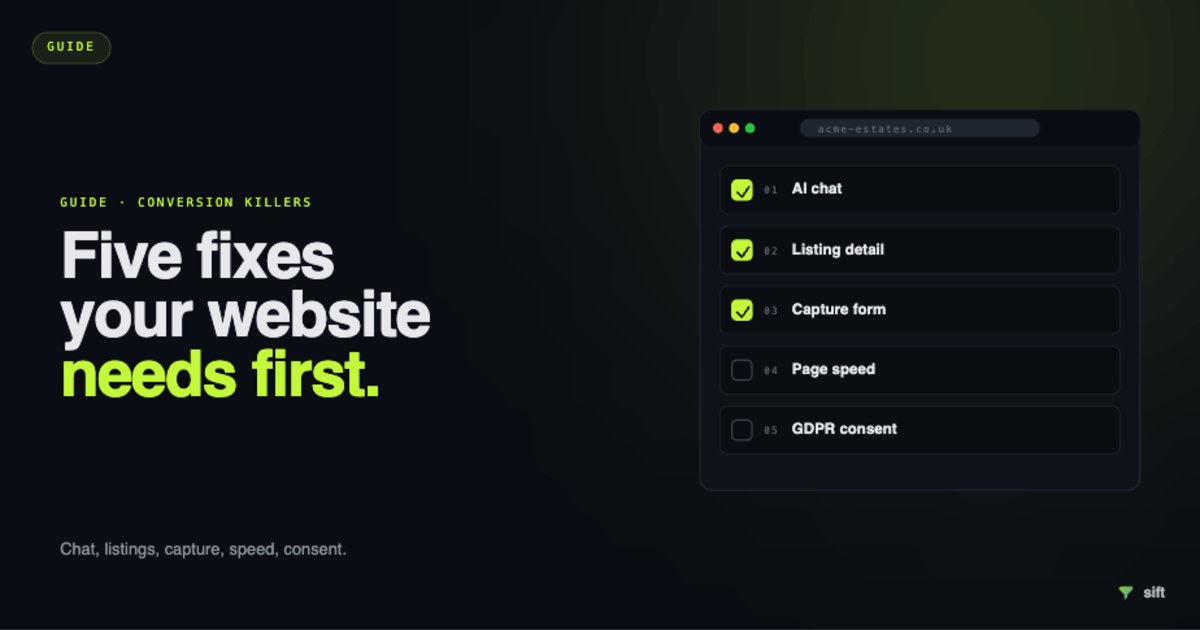
The 5 Conversion-Killers on Agency Websites
Before adding new tools or redesigning pages, it's worth diagnosing what's already breaking. These five issues appear on most agency websites and collectively account for the majority of missed enquiries.
No coverage outside office hours
Around 40% of property enquiries arrive outside office hours, in the evenings and at weekends (Moneypenny, 2025). If your website has no live response mechanism, only a contact form that sits unread until Monday, you're invisible to the visitors most motivated to act. A buyer browsing Rightmove at 9pm on a Sunday is ready to engage right now, not at 9am on Monday when your team is already juggling viewings.
Contact forms that ask too much too early
A form asking for name, email, phone, property address, budget, and message before providing any value will convert poorly. Most visitors aren't ready to hand over their phone number to an agent they haven't spoken to. The first interaction should feel like a conversation, not a data harvest.
No clear next action on listing pages
A buyer reads a property listing and is interested. What do they do next? If the answer is "scroll down to find the contact form," a significant proportion will leave instead. Every listing page should have an obvious, low-friction next step, a button to book a viewing, start a chat, or ask a question, visible without scrolling.
Slow response even during hours
Even if your team is in the office, enquiries submitted via web form during the day often sit for two to four hours before anyone responds. By that point, the buyer has already called one of your competitors. Speed-to-lead data consistently shows that the first agent to have a substantive conversation wins the buyer, not the best pitch delivered an hour later.
Missing qualification before contact
Many websites generate enquiries but don't distinguish between a buyer with a DIP who's chain-free and one who's at the very start of their property journey. Both fill in the same form. Your team can't prioritise effectively, and hot leads get the same response as cold ones. The result: frustrated serious buyers and time wasted on enquiries that were never going anywhere.
What a Lead-Generating Agency Website Actually Needs
Fixing the five killers above doesn't require a site rebuild. Most of these can be addressed with targeted additions to an existing site. Here's what the highest-converting agency sites have in common.
Contact Forms vs AI Chat: Which Converts Better
The single most impactful change most agency websites can make is replacing their primary contact form with an AI-assisted chat flow. The data on this is consistent across industries: guided conversational interfaces outperform static forms, particularly on mobile.
Here's why, in the specific context of an estate agency:
The practical difference: a form captures contact details. A chat widget captures contact details, qualification data, and a conversation, and it does it at 11pm on a Tuesday when no one from your team is available to take a call.
One thing contact forms do well: they're simple to audit for GDPR compliance. Good AI chat tools capture GDPR consent as part of the conversation flow, before collecting any personal data, and generate an audit trail automatically. Don't assume that adding chat means compromising compliance.
Your Listing Pages Are Your Best Lead Magnets
Every property listing on your website is effectively a landing page. A visitor who navigates to a specific property has already expressed a specific interest, they're at a much higher intent level than someone who arrived at your homepage.
Most agency websites treat listing pages as display pages: show the property, provide some details, and wait for the visitor to decide to make contact. This is leaving significant value on the table.
A listing page designed for lead generation does a few things differently:
- Answers common questions proactively. How much is council tax? What are the nearest schools? Is there parking? Is the property chain-free? Buyers who can't get these answers from your listing will search elsewhere or just leave. An AI chat widget connected to your property database can answer these questions in real time.
- Makes the next step obvious. A single, prominent button, "Book a viewing" or "Ask about this property", not buried below a wall of photos. On mobile, this should be visible without any scrolling.
- Captures early-stage interest. Some visitors aren't ready to book a viewing but are genuinely interested. A "save this property" or "get similar property alerts" option captures those visitors for future engagement, rather than losing them entirely.
- Loads fast. Property listing pages with large unoptimised image galleries load slowly on mobile. Every additional second of load time correlates with higher bounce rates. Compress images, use lazy loading, and test on a 4G connection.
Vendors: A Separate Funnel
Everything above applies primarily to buyer and tenant lead generation. Vendor leads, people considering selling their property and looking for an agent, need a separate consideration.
A vendor visiting your website is making a different decision. They're not reacting to a specific listing; they're evaluating whether to trust you with their largest asset. What they're looking for:
- Evidence that your agency sells properties quickly and at good prices
- Credentials, testimonials, and local market knowledge
- A valuation process that feels professional and not aggressive
- Easy access to book a market appraisal without a high-pressure commitment
A dedicated "Sell with us" or "Book a valuation" section of your website, separate from your property search, converts significantly better than sending vendors through the general contact form. If you're also using Sift for buyer enquiries, the same AI widget can handle valuation requests: capturing the vendor's property details, address, timeline, and whether they've already spoken to other agents, before routing to your team.
For more on the valuation process itself, see our guide on valuation enquiry response time and why speed wins more instructions.
Measuring Website Lead Performance
Most estate agents track total leads. Fewer track qualified leads. The distinction matters because a website generating 80 unqualified enquiries per month may be performing worse than one generating 30, if 25 of those 30 are proceedable buyers.
Four metrics worth tracking for website lead generation specifically:
Google Analytics provides data on the first metric. For the rest, particularly out-of-hours capture and qualification rate, you need either a CRM with good funnel tracking or a tool like Sift that captures these signals as part of the enquiry flow and records them against each lead (with a full pipeline funnel view available on Sift's Scale plan).
The Simplest Fix: Add AI Lead Capture
If you could only make one change to your agency website to improve lead generation, it would be this: add an AI chat widget that responds to enquiries immediately, 24/7, qualifies the buyer or tenant in a natural conversation, and delivers a scored lead record to your team each morning.
This addresses four of the five conversion-killers simultaneously: no out-of-hours coverage, form friction, slow response, and lack of qualification. It works on your existing site without any other changes, it's one script tag in your website header.
For the technical setup, see our guide on embedding the chat widget on your agency website. For a broader look at generating leads across all channels, portals, social, email, referrals, see our guide to estate agent lead generation in the UK. Sift starts from £149/month with a 14-day free trial and no card required.