The qualification problem in UK estate agency has two distinct parts, and most agents only solve one of them.
The first part is speed. Buyers who submit an enquiry at 10pm expect engagement quickly. Research consistently shows that leads contacted within five minutes are 21× more likely to be qualified than those called the next morning. No human team can cover that gap consistently. AI can.
The second part is depth. Speed to lead matters, but calling an unqualified buyer quickly just wastes time faster. A first-time buyer who hasn't spoken to a mortgage broker, has no Decision in Principle, and is casually browsing for "something to move into eventually" takes just as long to call as a chain-free cash buyer who needs to complete in six weeks, but only one of those viewings is worth booking.
AI lead qualification solves both problems simultaneously. This guide explains how.
1. What is AI lead qualification?
AI lead qualification is an automated system that asks structured qualification questions to every visitor on your agency website, before the first agent gets involved. It's not a chatbot that answers questions. It's a system that asks them.
When a buyer or tenant lands on your website, the AI initiates a conversation, collects their GDPR consent, then works through a short structured interview: are they buying or renting? What's their situation, chain-free, under offer, nothing to sell? Do they have a Decision in Principle? What's their budget and timeline?
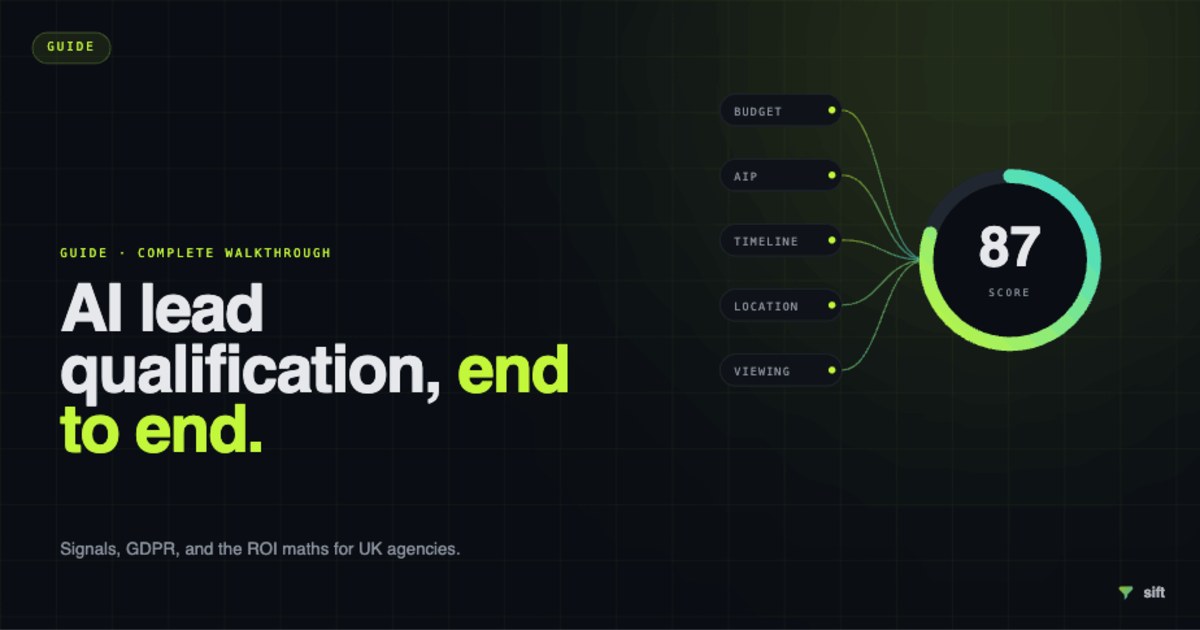
The answers are captured, scored against your qualification rules, and a lead record is created in your dashboard. When your negotiator starts their day, they see a prioritised list: hot leads at the top (chain-free, DIP in hand, motivated buyer), lukewarm leads in the middle (serious but not ready), and low-priority enquiries filtered to the bottom.
"The difference between AI lead qualification and a chatbot is the output. A chatbot produces a conversation. AI lead qualification produces a qualified lead record."
The entire process takes 2-3 minutes from a buyer's perspective and requires zero staff time. It happens at midnight just as easily as it happens at 9am. Why this matters in 2026 →
2. Which signals should an AI qualification system capture?
This is where UK-specific AI lead qualification diverges sharply from generic chatbots or tools built for other markets. The signals that determine whether a UK buyer is worth calling are unique to British property transactions.
A tool built for US apartment leasing has no concept of "chain status", there are no property chains in American real estate. A generic chatbot that asks "are you pre-approved?" is using US mortgage terminology that doesn't translate to the UK's Decision in Principle framework. The 6 signals that actually matter →
The seven signals a UK AI qualification system should capture:
Chain status
First-time buyer / under offer / sold STC / property to sell / nothing to sell. The single most predictive signal of transaction speed. Chain-free buyers complete faster and fall through less often.
Decision in Principle (DIP/AIP)
Formal mortgage agreement in principle from a lender, not just "I've spoken to a broker." A DIP means a buyer has been credit-checked and approved up to a specific amount. "Exploring" is a very different situation.
Government scheme eligibility
Help to Buy, Shared Ownership, First Homes scheme. These buyers can only purchase eligible properties, have price caps, and need specialist solicitors. Flagging this early saves a viewing on the wrong property.
Budget and price range
Not just maximum, whether their budget is confirmed (DIP in hand) or estimated. A buyer with a £400k DIP is different from a buyer who "thinks they can borrow about £400k."
Move-in timeline
Immediately, 3 months, 6 months, "just looking." Agents with limited viewing slots should prioritise buyers who need to move in the next 8-12 weeks over those at the early browsing stage.
Buyer / tenant / vendor identification
Is the visitor a buyer, a tenant, or an owner looking to instruct? Many agencies serve multiple purposes and need to route enquiries correctly from the first contact.
Property type preference
House, flat, new build, period property. Helps pre-filter which of your listings to show and which negotiator to assign based on specialism.
Cash buyer verification
"Cash buyer" in the UK can mean genuinely mortgage-free or someone who hasn't put their own property on the market yet. The follow-up question changes the lead score entirely.
Together, these signals give a negotiator everything they need to make a go/no-go decision before picking up the phone, rather than spending the first five minutes of a call establishing facts that could have been captured automatically.
3. How AI lead qualification works
The technical flow of an AI lead qualification system involves six steps, from the visitor's first page load to the lead record appearing in your dashboard:
The entire process takes 2-3 minutes from the visitor's perspective and works identically at midnight as it does at 9am. How speed to lead affects conversion →
4. Integration with UK estate agent CRMs
For AI lead qualification to fit into an existing agency workflow, qualified leads need to be available to the CRM the team already uses, not stranded in a parallel system that requires manual checking.
Sift's approach is dashboard-first plus routing on Growth and Scale. Every qualified lead lands in the Sift dashboard with full transcript, GDPR consent record, lead score and contact details, exportable via CSV on every plan. On Growth and Scale, you can route the same record into any system via Zapier (6,000+ apps), an outbound webhook, or the REST API. Native CRM integrations for Alto, Reapit, Dezrez, Jupix, Loop, Street and Rex are on the roadmap.
The six main UK estate agent CRMs and how Sift fits today:
For any system not in that list, Zapier connects to 6,000+ apps, any CRM that accepts data from Zapier can receive qualified lead records on Growth and Scale. Starter customers can export the same data via CSV from the dashboard.
The key principle for routing is that AI qualification should be additive, not disruptive. It works alongside your existing CRM, adding structured qualification data to leads that would otherwise arrive as a name and email address with no context.
5. GDPR considerations for AI lead qualification
UK estate agents are subject to UK GDPR (retained from EU GDPR post-Brexit) and regulated by the Information Commissioner's Office (ICO). Any system that collects personal data from website visitors needs to comply, and AI lead qualification, by definition, collects personal data.
The key requirements for GDPR-compliant AI lead qualification:
- Consent before data collection. Visitors must explicitly consent before the AI asks any qualifying questions. Consent must be specific, informed, and freely given, pre-ticked boxes don't count. The consent event must be logged with a timestamp and the consent language shown.
- Data minimisation. Only collect the data you actually need to qualify the lead. Chain status, DIP, budget, and timeline are necessary. Date of birth, national insurance number, and bank account details are not.
- Purpose limitation. Data collected for lead qualification should be used for lead qualification and follow-up, not sold to third parties or used for unrelated marketing purposes.
- Subject access and erasure. Buyers have the right to request their data and the right to erasure. Your qualification system needs a mechanism to identify and delete a specific lead's data on request.
- Data processor agreements. The AI lead qualification provider is a data processor on your behalf. You need a Data Processing Agreement (DPA) with them, and responsible providers will supply one as part of their terms.
The lawful basis most applicable to AI lead qualification is legitimate interest (responding to an inbound business enquiry) combined with explicit consent collected at the start of the conversation. Estate agents should document their basis in their Records of Processing Activity (ROPA). Full guide to AI and GDPR for estate agents →
6. How to choose an AI lead qualification tool
The market includes tools that range from generic chatbots badged as "AI lead qualification" to purpose-built UK estate agent platforms. The criteria that actually matter:
See a full comparison of the main tools on the UK market: Sift vs EstatAI · Sift vs Street Cortex · Sift vs SalesRook
7. ROI calculation: how much is AI lead qualification worth?
The return on AI lead qualification is straightforward to calculate for estate agents because the value of a qualified lead is measurable: it's a fraction of the average commission on a completed sale or let.
Example calculation for a mid-sized sales agency:
80 website enquiries per month × 40% would qualify under AI (32 qualified leads) × 15% viewing-to-offer conversion (4.8 offers) × 40% of offers completing (1.9 sales) × £3,500 average commission = £6,650/month in incremental revenue captured.
Even if the true number is half that, because some of these enquiries would have been qualified manually anyway, £3,300/month in recovered revenue against a £149-299/month tool cost represents a 10-20× return.
The calculation is conservative because it only counts sales completions. It doesn't count: lettings (where speed to lead is equally critical), referrals from buyers who had a good first experience, or the negotiator time freed from qualifying calls.
The more significant ROI driver is often the out-of-hours recovery rate. If 40% of your enquiries arrive outside office hours (Moneypenny, 2025) and currently receive zero qualification, the AI is not competing with your existing process, it's creating a new pipeline that didn't exist before.
Ready to implement AI lead qualification?
Sift is built specifically for UK estate agents. It captures all seven qualification signals covered in this guide, delivers qualified leads to the Sift dashboard with full transcript and consent record (CSV export on every plan; Zapier, outbound webhook and REST API on Growth and Scale), has a UK GDPR consent flow designed to ICO standards, and installs on your agency website with a single script tag in under 10 minutes. Native CRM integrations are on the roadmap.
View pricing from £149/month for independent agencies to £549/month for multi-branch operations. All plans include a 14-day free trial with no card required.