A buyer submits an enquiry on your website at 7.43pm on a Tuesday. By the time your team opens their emails at 9am Wednesday, that buyer has also enquired with two other agencies, had a response from one of them at 8.02pm the same night, and is already planning a viewing for Thursday.
Your team calls at 9.15am. The buyer is polite but noncommittal. "Still looking," they say. They complete a purchase through the other agency six weeks later. For a qualification framework that closes the response gap, read our guide to AI lead qualification for UK estate agents.
This isn't a fictional scenario. It's the default outcome for every agency that hasn't addressed its lead response gap, and it costs the UK property market an estimated £119m a year in missed business.
What the research says about response time
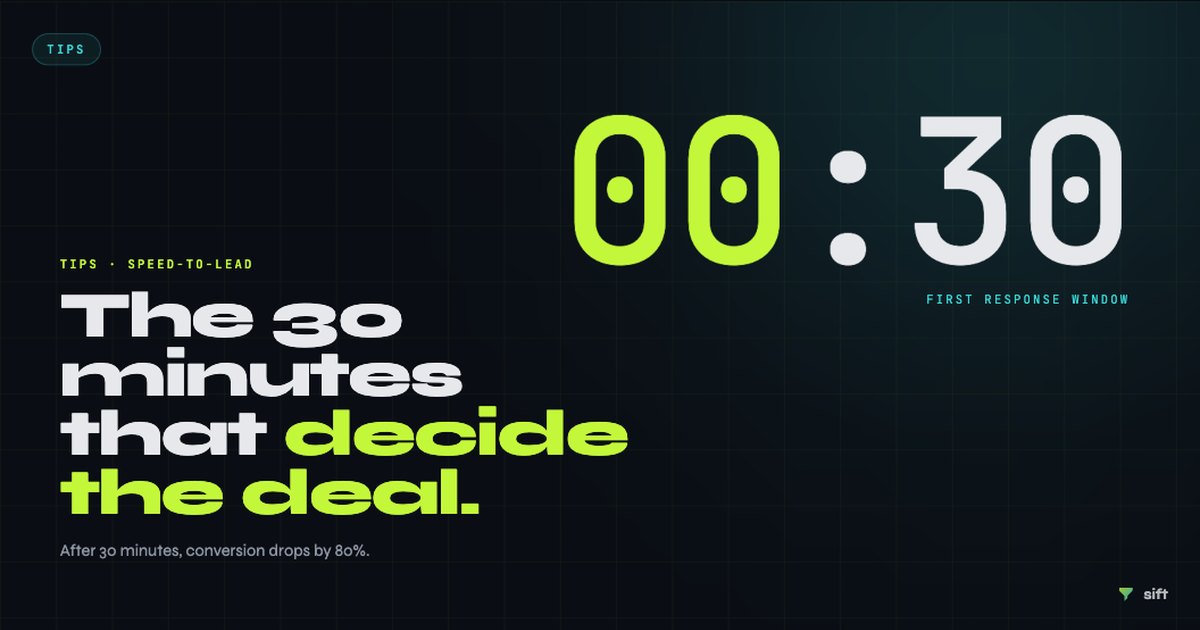
The relationship between lead response time and conversion probability is well-documented across industries. The pattern in UK estate agency mirrors what's seen in other high-consideration purchase categories: conversion likelihood drops sharply after the first 30 minutes and falls to near-zero after 24 hours.
The 15-hour average response gap isn't an aberration, it's the predictable result of a model where human teams handle enquiries during business hours only. When 40% of enquiries arrive outside those hours, 40% of leads wait overnight before anyone has made contact.
Why response time matters more in property than most sectors
In property, several factors amplify the cost of slow response:
Buyers enquire with multiple agencies simultaneously
Portal listings make it trivial for a buyer to submit an enquiry to three or four agents in one sitting. The agent who responds first, and responds well, sets the terms for that buyer's search. Speed doesn't just increase conversion probability; it determines which agency gets to have the qualifying conversation at all.
Buying intent decays quickly
Property purchasing decisions are made over weeks, not days or months. A buyer who is actively searching today may find a property through another agent tomorrow. The window between "interested in this listing" and "actively engaging with someone" is short, often 24-48 hours. A response that arrives outside that window often lands in dead air.
The first contact is also the first qualification
Every response to a property enquiry is an opportunity to ask the six questions that determine whether the buyer is worth prioritising: chain status, DIP/AIP, cash buyer status, buyer scheme eligibility, confirmed budget, and timeline. An agent who responds first and qualifies the buyer in the first conversation has a significant advantage over one who responds hours later to a buyer who has already had that conversation elsewhere.
The response time decay curve
Here's how conversion probability changes as response time increases, based on UK estate agency data:
The implication is stark: the 40% of enquiries that arrive out of hours and wait 15 hours for a response are arriving into the agency pipeline at a point where their conversion probability has already collapsed.
Where speed and qualification intersect
Speed to lead and lead qualification are often treated as separate concerns. They're not.
A fast response to an unqualified lead wastes time, you've re-engaged a buyer who has no DIP, an unsold property, and a 9-month timeline. A slow response to a qualified lead wastes the lead, you've missed a chain-free cash buyer who went with the agent who came back to them first.
The combination that actually works is: fast response and qualification in the same interaction. The response that asks "are you chain-free? Do you have a DIP?" in the first minute is worth more than a fast response that just says "thanks for your enquiry, we'll call you tomorrow."
Responding fast is table stakes. Responding fast and capturing chain status, DIP, and timeline in the first conversation, that's the actual competitive advantage.
Three reasons most agencies haven't fixed this
1. The problem is visible only in aggregate, not per-lead
Individual leads that go cold don't generate visible evidence of failure. The buyer doesn't call back to say "I went with your competitor because you were slow." They just disappear. The agency's pipeline looks normal; what's invisible is the parallel pipeline of leads that never entered it. This makes the problem easy to dismiss and hard to quantify until you actively measure response time.
2. Hiring more staff doesn't solve the timing problem
Adding negotiators to handle enquiries helps during business hours. It does nothing for the 40% of enquiries that arrive in the evenings and on weekends. The problem isn't headcount, it's coverage hours. More people working 9-6 doesn't extend coverage to 6-9.
3. Generic chatbots don't ask the right questions
Some agencies have tried adding a general-purpose chatbot to their website, expecting it to solve the response time problem. It collects contact details but doesn't capture chain status, DIP, or the other qualification signals that make a lead actionable. The result is faster response but no improvement in lead quality, you've just automated the message-taking step, not the qualification step.
What closing the gap actually looks like
The agencies that have brought their effective response time from 15 hours to under 30 minutes have done it in three stages:
Measure the current gap
Before changing anything, record your average response time for enquiries received outside 9am-6pm Monday-Friday. This is your baseline. Track it in your CRM as a field against each lead, time enquiry received vs time of first team contact. Most agencies find the number is worse than they thought.
Install a qualification layer that runs 24/7
A website-based AI qualification agent handles the initial response at any hour, capturing chain status, DIP, buyer scheme, budget, and timeline in a 2-3 minute conversation. The buyer gets an instant, substantive response rather than silence. The negotiator opens a scored lead in the Sift dashboard the next morning with the key signals already captured, exportable to your CRM via CSV on every plan, or routed via Zapier, webhook or the REST API on Growth and Scale.
Route hot leads differently
With qualification data already in the Sift dashboard (and routed to your CRM via CSV, Zapier, webhook or API), your morning call list is sorted: chain-free buyers with DIPs at the top, long-timeline browsers at the bottom. Your team calls the hot leads first, the leads where speed still matters, rather than working through an undifferentiated inbox in arrival order.
What to measure after 30 days: Compare your out-of-hours lead qualification rate (percentage of evening/weekend enquiries that received a qualification conversation before 9am the next morning) against the prior month's baseline. For most agencies starting from zero, this goes from 0% to 90%+ in week one. The downstream metric, viewing-to-offer conversion on out-of-hours leads, typically follows within 6-8 weeks.
The compounding effect
Speed to lead isn't just about the individual lead. Over 6-12 months, consistently fast and qualified responses to every enquiry, including the 40% that arrive out of hours, compounds into a reputation effect.
Buyers talk to each other. A buyer who received a substantive response at 11pm is more likely to recommend the agent to a friend. Portals increasingly surface agencies with strong response metrics. And internally, a team that starts each morning with pre-qualified, scored leads rather than an undifferentiated inbox makes faster decisions, books better viewings, and closes more offers.
The agencies treating speed to lead as a metric, not just a vague aspiration, are the ones building pipeline advantages that compound. The ones waiting for the market to slow down so they can "catch up on enquiries" are permanently behind.
Where to start
If your average response time to out-of-hours enquiries is over 2 hours, the highest-ROI thing you can do this week is install a 24/7 AI qualification layer on your website. It doesn't replace your negotiators, it makes them more effective by giving them pre-qualified leads every morning and eliminating the 15-hour response gap that costs you leads you never know you're losing.
Sift installs in under 10 minutes with a single script tag. 14-day free trial, no card required. Plans from £149/month.