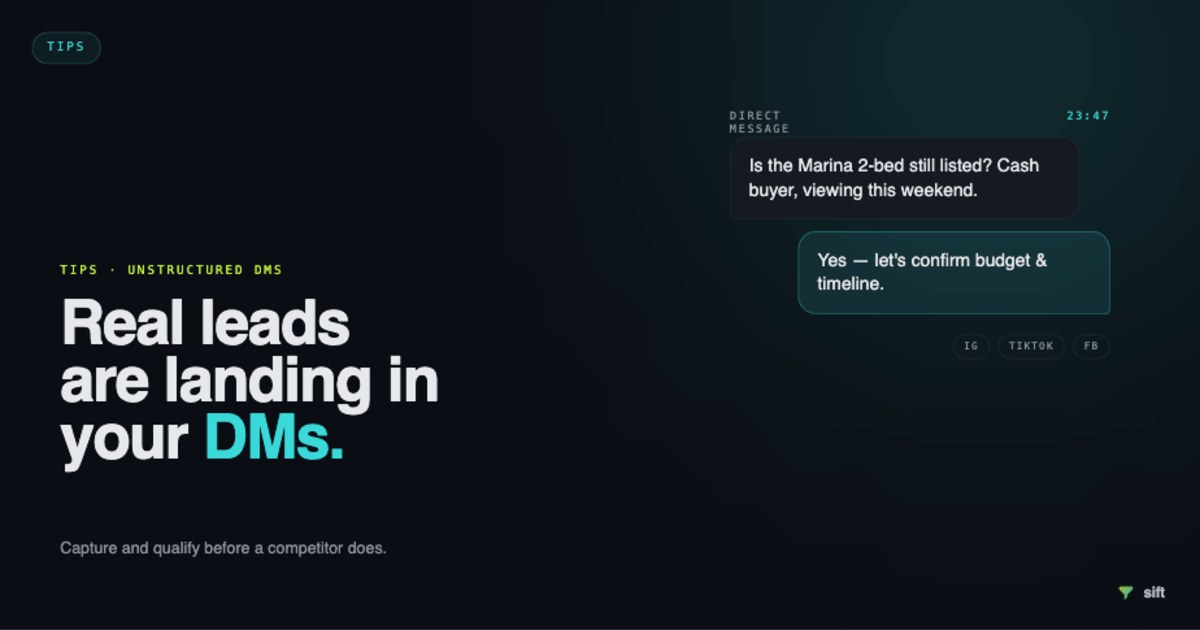
Picture this: a property you posted on Instagram gets a DM on Saturday night. "Hi, we've been looking for exactly this kind of place for months, is it still available? Can we arrange a viewing?" By Monday morning when you see it, the couple has already booked a viewing through Rightmove with a competing agent.
Social media leads are real. For agents who've built an audience, even a modest local following, they arrive regularly. The challenge isn't generating them. It's that they arrive in a format that makes qualification almost impossible without adding significant manual work to an already stretched team. The same AI lead qualification approach that handles Rightmove enquiries can handle social leads too.
Why social media now generates serious property enquiries
Three years ago, most estate agents treated social media as a brand awareness channel. Post some nice photos, collect likes, maybe get a few follows from local homeowners. The idea that a buyer would use Instagram as part of their property search felt unlikely.
That's changed. The UK property market on social media has grown considerably: estate agent accounts with detailed property tours, neighbourhood content, and market commentary now regularly attract buyers and tenants who prefer discovering properties through their existing social feeds rather than searching Rightmove cold. Instagram Reels and TikTok property tours consistently drive DMs asking about specific listings.
Facebook remains the most active channel for older buyer demographics, with local property groups in most UK towns attracting tens of thousands of members. A single post in the right Facebook group can generate more enquiries than a week of Rightmove impressions, but those enquiries arrive as comments and DMs rather than structured forms.
The structural problem: unstructured data at the wrong time
Portal enquiries have a critical advantage over social media leads: structure. When a buyer enquires on Rightmove, you receive their name, email address, and phone number as a minimum. You know which property they enquired about, you have a timestamp, and the enquiry sits in a system that generates follow-up reminders.
A social media enquiry gives you a message. That's it. You don't know their budget, their timeline, whether they have anything to sell, or whether they're mortgage-ready. Before you can decide whether to spend 45 minutes driving across town to show them a property, you need to find all of that out, manually.
The qualification status row tells the real story. No lead source, portal, social, or website, tells you upfront whether the person is proceedable. But portals at least give you enough contact data to follow up quickly. Social media enquiries add an extra manual step before you even get to the qualification conversation.
The 5 questions every social media lead must answer
Before you spend time chasing a social media enquiry, you need answers to the same five questions you'd ask any buyer or tenant. The problem on social is finding a way to gather these without a formal form, and doing it at a time when you're almost certainly not at your desk.
Buying, renting, or selling?
Establishes the conversation track immediately. A vendor enquiry needs a different follow-up than a buyer.
Budget or price range?
Not just a number, does it match the property they've enquired about? Many social followers don't register price from the post.
Mortgage in principle in place?
The fastest signal of whether a buyer is proceedable. Without a DIP or AIP, a viewing is often premature.
When do they want to move?
Timeline filters out aspirational enquiries. "Sometime next year" needs different handling than "in the next 6 weeks."
Anything to sell first?
Chain status is the most frequently overlooked qualification question on social, where the conversation is friendly rather than formal.
Asking these five questions manually for every social enquiry adds 10-15 minutes per lead, before you've even decided whether to follow up. For a team already handling portal enquiries, that overhead compounds fast.
The response-time cliff on social media
Portal buyers tolerate a multi-hour response window. They've submitted a form; they expect a call the next morning or even the following day. The format implies a degree of patience.
Social media is conversational. When someone sends a DM, they're in messaging mode, and messaging platforms show read receipts. Your delay is visible. A buyer who messages you at 10:45pm on Saturday and sees their message has been read by Sunday morning but not replied to has already drawn their conclusion.
The harder truth is that most social enquiries come from buyers who are also on Rightmove. They've seen the property through both channels. If your portal response happens to arrive before your social response, they'll simply book the viewing through the portal. The social enquiry disappears without ever converting.
The window that matters: Research consistently shows that property enquiries responded to within one hour convert at significantly higher rates than those contacted the following day. On social media, where instant messaging is the norm, that window compresses further, and around 40% of all enquiries arrive when no one is available to respond at all.
The optimal social lead funnel
The solution isn't to monitor your Instagram DMs 24 hours a day. It's to intercept social media interest at the point of click, before it becomes an unstructured DM, and route it through the same qualification flow you use for website and portal visitors.
Add a clear CTA to every social post and your bio
"Find out more, link in bio" or "Book a viewing, link in bio." Make the destination explicit so interested followers click rather than DM. Instagram Stories and Reels both support direct link stickers that can point to your agency site.
Link in bio points to a page with your qualification widget
This can be a dedicated landing page or your main site, as long as the page has your chat widget above the fold. Someone who clicks from Instagram at 10pm should immediately be prompted to answer the five qualification questions, not hunt for a contact form.
AI qualification runs immediately, regardless of the time
Sift's widget is available 24/7. A visitor who clicked from your Instagram bio at 11pm gets the same qualification flow as someone who found you on Rightmove at 2pm, budget, chain status, mortgage status, timeline, all captured conversationally before they leave.
Qualified lead data in your dashboard by morning
By the time you open your laptop on Monday, the buyer who clicked from Saturday's Instagram post is in your lead dashboard with a qualification score, contact details, and all five answers. You know in two minutes whether they're worth calling, and what to say when you do.
What to do with DMs that still come in
Even with a well-optimised bio link, some followers will still DM directly, especially for specific properties they've seen in a post. For these, the approach is simple: reply immediately with your qualification link.
A single template response works for every scenario: "Thanks for your message! To make sure I can give you all the details you need, head to [link] and our system will confirm availability and get you set up. It takes about 2 minutes."
This accomplishes three things: it acknowledges the enquiry instantly (eliminating the response-time problem), it routes the lead into a structured qualification flow, and it sets the expectation that a fuller conversation follows. Most genuinely interested buyers click through. Those who don't were unlikely to book a viewing regardless.
Tracking social media lead quality
Once your social leads flow through the same qualification system as your website and portal enquiries, you can start measuring what you couldn't before: which channel produces the most proceedable buyers.
The data often surprises agents. Social media leads from personal brand accounts, where the agent posts market commentary and local knowledge rather than just property listings, frequently show higher qualification rates than cold portal enquiries. The buyers have been following you for months. They already trust you. When they finally enquire, they're often further along in their decision than a first-time Rightmove enquirer.
Four metrics worth tracking once you have the data:
- Lead volume by source: how many social leads vs portal vs direct website each month
- Qualification rate by source: what percentage of social leads are proceedable
- Viewing conversion rate: of qualified social leads, how many become booked viewings
- Time to first response: the gap between a social click and the AI conversation starting (should be near-zero)
The goal isn't to prove social media is better than portals, it usually isn't in raw volume terms. The goal is to stop losing the social leads you're already generating because the mechanics for capturing them don't exist.
Sift works the same whether a visitor clicked from Rightmove, your website, or your Instagram bio. One widget, every source, all leads qualified and scored before you make the first call. Plans start from £149/month with a 14-day free trial.