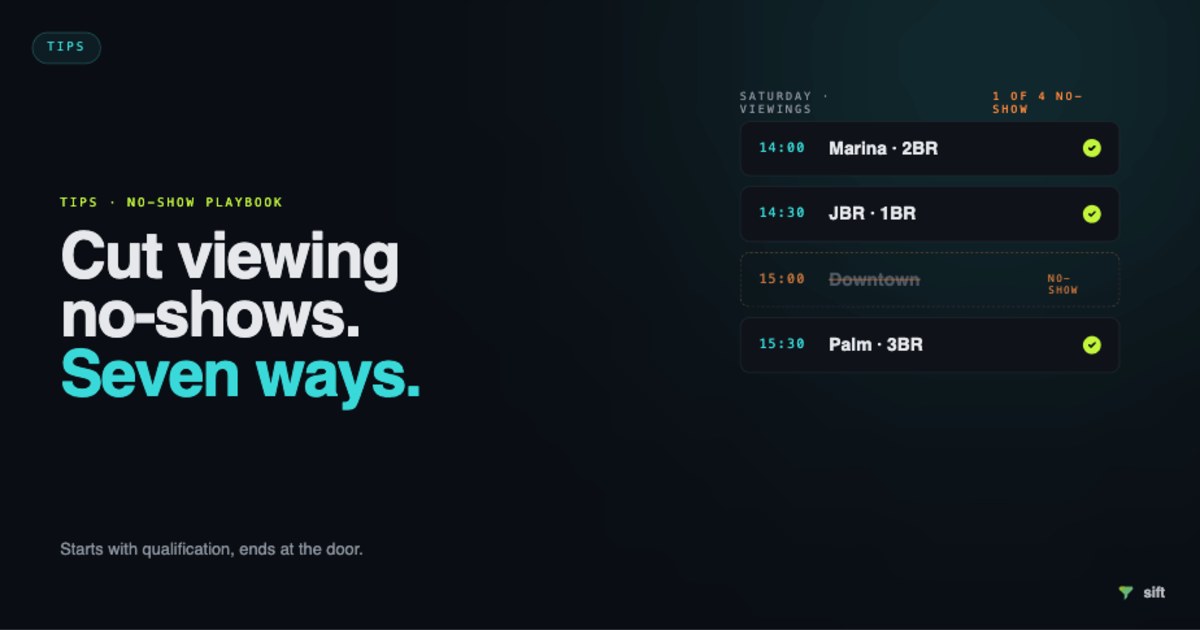
The no-show problem most agents underestimate
A viewing no-show isn't just a wasted afternoon. Add up the negotiator travel time, the preparation, the time the vendor spent tidying their property, and the viewing slot that a qualified buyer could have used, and a single no-show costs your agency somewhere between £50 and £150 in real terms. At a 20% no-show rate with 50 viewings per month, that's £500-£1,500 disappearing quietly every four weeks. For a qualification framework that prevents unserious buyers from reaching the viewing stage, see our guide to AI lead qualification for UK estate agents.
The frustrating part is that most no-shows aren't random. They cluster around a specific type of enquirer: someone who submitted a portal form impulsively at 10pm, booked a viewing before they'd secured a mortgage in principle, or who was simultaneously viewing three other properties with three other agencies. These are predictable patterns, and the solution starts much earlier than the day of the viewing.
Why buyers and tenants don't show up
Before fixing the problem, it helps to understand the five reasons UK property viewers go silent:
Seven ways to cut your viewing no-show rate
These tactics are ordered by where they sit in the process, starting before the enquiry is even booked, and ending with recovery when a no-show happens anyway.
Qualify leads before they book a viewing
This is the highest-leverage intervention. If you don't know whether an enquirer has a DIP, a realistic budget, a confirmed timeline, and no chain complications, you don't know whether they should be booking a viewing at all. Agencies that add a qualification step before the booking (not after) report no-show rates below 10%.
The practical challenge is capacity: qualification conversations during business hours require a negotiator's time. An AI qualification system, a chat widget on your agency website that asks 5-7 structured questions before passing the lead to your team, handles this automatically and out of hours, when portal impulse enquiries spike.
→ See the 6 signals that make a buyer proceedableOnly confirm viewings for proceedable enquirers
A buyer who can't confirm they have a DIP in place or that their current property is either sold or not applicable is not ready for a viewing. This isn't about being difficult, it's about protecting your negotiators' time and the vendor's trust. Be direct: "We can book a viewing as soon as you've confirmed your mortgage in principle. Here's a link to our mortgage partner if you need one."
This single policy change, applied consistently, eliminates the largest single category of no-shows: people who were interested but not yet able to proceed.
Confirm 24 hours before, and require a reply
A passive confirmation (calendar invite, booking confirmation email) does nothing to prevent no-shows. An active confirmation, "Are you still coming tomorrow at 2pm? Please reply YES to confirm or let us know if anything has changed", requires a micro-commitment that surfaces problems early.
Send via SMS or WhatsApp (not email, open rates are far higher). If you get no reply to the 24-hour confirmation, call. A second unreturned contact is a strong signal the viewing won't happen. Reassign the slot and confirm a waitlisted enquirer instead.
Ask buyers to describe what specifically interests them
At booking confirmation, ask: "What is it about this property that you'd most like to see on the viewing?" This question does two things. First, it prompts the buyer to think concretely about the property, reactivating their motivation. Second, the answer tells you whether they actually understand what they're viewing (garden size, layout, location) or whether they're booking vaguely.
A buyer who can't answer this question was probably booking speculatively. A brief exchange at this stage costs you 30 seconds but surfaces low-intent bookings before the viewing day.
Time viewings to match buyer availability, not convenience
Midday weekday viewings have higher no-show rates than weekend mornings or weekday evenings. Most buyers in employment can't get away at 11am on a Tuesday without significant friction, so when something comes up at work, the viewing is the thing that gets dropped.
Offering weekday evening slots (5-7pm) and Saturday morning blocks reduces the "it's inconvenient today" cancellation. It also signals to the buyer that you've built a schedule around their constraints, not yours, a small trust-builder that increases commitment to the booking.
Confirm the vendor's property is correctly described
A significant category of no-shows happens because the buyer discovers something between booking and viewing that changes the calculus: the property is closer to a main road than they thought, the rear extension they assumed existed isn't there, or the photos make the garden look larger than it is.
Brief buyers on any property details that commonly disappoint during viewings before the viewing happens. It feels counter-intuitive to flag potential negatives, but it reduces the "I did some research and it's not right for us" cancellation, which tends to arrive via a single text message at 7am on the day.
Build a waiting list for popular properties
For in-demand properties, keep a short waitlist of qualified enquirers who couldn't get a slot. When a same-week no-show happens, and some always will, you can fill the slot within the hour by calling the waitlist. This turns the no-show from a dead afternoon into a last-minute opportunity.
The waitlist only works if the people on it are pre-qualified. A waitlist of unscreened enquirers just introduces uncertainty about whether the replacement viewer will show up either.
How pre-qualification addresses the root cause
Of the seven tactics above, qualification before booking has the highest no-show reduction impact because it addresses four of the five root causes simultaneously. A buyer who is pre-qualified as proceedable, chain-free or sold, DIP in hand, confirmed budget, 3-month timeline, is a fundamentally different category of viewer from someone who clicked an enquiry form at 10pm.
The challenge with manual qualification is capacity. Asking qualification questions during business hours means a negotiator has to be available to have the conversation. Out-of-hours enquiries, which make up a large proportion of portal traffic, go into a queue and are qualified the next working day, by which point some of the urgency has dissipated.
AI lead qualification tools solve the capacity problem. A chat widget on your agency website that proactively opens a qualification conversation when a visitor shows purchase intent, asking about chain status, DIP, budget, timeline, can handle this 24/7 without staff involvement. The lead record that arrives in your dashboard the next morning already has a qualification score attached.
The compounding benefit: Fewer viewings per month, but a higher conversion rate from viewing to offer. An agency running 40 pre-qualified viewings per month will typically generate more offers than the same agency running 60 unscreened viewings, because the qualified viewings include far fewer people who were never going to buy.
What to do when a no-show happens anyway
Even with systematic pre-qualification and active confirmation, some no-shows are unavoidable, life events, family emergencies, genuine work crises. The recovery process matters:
Contact within 2 hours
A short, non-confrontational message: "We missed you at the viewing today. Is everything OK? We're happy to rebook when you're ready." This recovers some of the relationship and sometimes surfaces a reschedulable booking.
Reassign the slot immediately
Call your waiting list or check whether a recently-qualified enquirer on a similar brief could be offered the slot. The vendor will appreciate the effort and it keeps viewing momentum going on the property.
Record the pattern
Which lead sources have the highest no-show rates? Which time slots? Which property types? Three months of data usually reveals one or two actionable patterns, a portal source, a time slot, or a property category that consistently underperforms.
Don't rebook immediately on the same day
Chasing a no-show to rebook on the same call often backfires. Give it 48 hours, then offer a rebook with a confirmation requirement. If they don't respond, move them to a cold-lead category.
The viewing-to-offer conversion benchmark
No-show rate and viewing-to-offer conversion are two sides of the same quality metric. The average UK residential estate agency converts roughly 1 in 10-15 viewings into an offer. Agencies that pre-qualify consistently report ratios closer to 1 in 6-8, not because their properties are more desirable, but because the viewings that happen are with people who are actually ready to buy.
If your current viewing-to-offer ratio is below 1 in 12, and your no-show rate is above 20%, the problem is almost certainly at the enquiry stage rather than the viewing stage. Improving the quality of who books viewings, rather than improving how viewings are conducted, will move the number faster than any amount of viewing technique coaching.
"We don't need more viewings. We need fewer, better ones."
That's the underlying principle. A smaller number of qualified, motivated, proceedable buyers converting at a higher rate generates more revenue and less operational waste than a large volume of mixed-quality viewings at a high no-show rate.
Frequently asked questions
What is a good viewing no-show rate for UK estate agents?
Below 10% is achievable with systematic pre-qualification. The industry average is closer to 15-25%. If your no-show rate is above 20%, the issue is almost certainly at the enquiry and booking stage, not on the day of the viewing itself.
Should you charge a deposit to reduce viewing no-shows?
Most UK residential agents don't charge deposits for viewings, it adds friction that deters genuine buyers. The better approach is pre-qualification: establishing DIP, timeline, and chain status filters out most low-intent enquirers without any financial barrier.
When should you confirm a viewing to reduce no-shows?
Confirm 24 hours before via SMS or WhatsApp, and require a reply. A passive confirmation (calendar invite) doesn't reduce no-shows. Ask directly: "Are you still coming tomorrow at 2pm? Please reply YES." For high-value viewings, add a 2-hour reminder on the day.
Why do buyers book viewings and then not show up?
The most common causes: booked with multiple agents simultaneously and attended a competing viewing, no DIP so they weren't actually ready to proceed, impulsive late-evening enquiry with low commitment, or a property-requirement mismatch discovered between booking and viewing day. Pre-qualification catches most of these before a viewing slot is wasted.
Can AI qualification tools help reduce viewing no-shows?
Yes. AI qualification tools screen enquirers before they reach the booking stage, asking about DIP status, chain status, budget, and timeline. Enquirers who don't meet your qualification threshold don't get offered a viewing until they do. This reduces viewing volume but significantly improves the viewing-to-offer conversion rate. Learn how AI lead qualification works.
Sift screens buyers before the viewing stage, asking about mortgage status, chain position, and timeline, so viewings go only to buyers who qualify. Plans from £149/month.