A negotiator who books 20 viewings a month and converts 4 into offers is working much harder than one who books 12 and converts 5. More viewings is not the goal. Better viewings, with better-qualified buyers, is what moves revenue.
UK estate agents typically see wide variation in viewing-to-offer conversion rate depending on market conditions, property type, and how their qualification process works. The range is large enough that improving it by 10 percentage points on a typical caseload can double the number of offers a negotiator generates each month. Our guide on AI lead qualification for UK estate agents covers the qualification layer that drives this improvement.
What Viewing-to-Offer Conversion Actually Measures
Viewing-to-offer rate = offers received ÷ viewings conducted × 100. A rate of 20% means one in five viewings generates an offer. A rate of 40% means two in five do.
It is worth being clear on what this metric captures and what it doesn't. It doesn't tell you whether offers are accepted, whether sales complete, or whether the buyer is proceedable. A high offer rate with many gazundering incidents or high fall-throughs is not a success. But as a leading indicator of pipeline health, it is the most useful operational metric a negotiator can track.
Why Most Viewings Don't Become Offers
When a viewing doesn't generate an offer, the reason usually falls into one of four categories. Understanding which category dominates your pipeline tells you where to focus.
The good news: three of these four categories are partially or fully within an agent's control. Only price objections (which depend on vendor expectations and market conditions) are harder to address in the short term.
Lever 1: Pre-Viewing Qualification
The single highest-leverage action you can take to improve viewing-to-offer conversion is to raise the bar for who gets a viewing in the first place. This sounds counterintuitive, fewer viewings feels like less activity, but the math is straightforward.
An agent booking 20 viewings/month with a 12% offer rate generates 2.4 offers. The same agent booking 14 viewings with a 28% rate generates 3.9 offers. 30% fewer viewings, 63% more offers.
Pre-viewing qualification means confirming, before booking a slot, that the buyer has:
- Mortgage in principle (DIP/AIP) or proof of cash funds. No DIP = no viewing, unless the property is new to market and you can afford to be flexible in week one.
- A realistic budget for this property. If their DIP is for £280k and the property is £340k, find out before you both waste an afternoon.
- A workable chain position. A first-time buyer or someone with a sold subject-to-contract property is a better use of your time than someone who hasn't yet instructed an agent.
- A genuine timeline. A buyer who says they're "just exploring" for the next 12 months is unlikely to convert this viewing into an offer this quarter.
Pre-qualification is not gatekeeping. It's alignment. A buyer who isn't mortgage-ready yet doesn't benefit from viewing properties they can't buy, and being told that upfront, with a recommendation to sort their DIP first, is better service than letting them fall in love with a property they can't proceed on.
For a full breakdown of the qualification signals that matter most before a viewing, see our guide on how to qualify property buyers in the UK.
Lever 2: The Post-Viewing Follow-Up Window
Buyers make their decision about whether to offer within a relatively short window after a viewing, usually in the car on the way home, over dinner that evening, or the following morning. The agents who reach them during that window get the offer. The agents who follow up three days later are often too late.
The post-viewing call script
The goal of this call is to gather honest feedback, not to push for an offer. Buyers who feel pressured become evasive. Buyers who feel heard, and that their concerns are being taken seriously, are more likely to offer, and to offer at a reasonable level.
Lever 3: Handling the Four Main Objections
Most post-viewing rejections come down to four objections. Each has a handling approach that doesn't require pressure or false urgency.
Using Viewing Feedback as Qualification Intelligence
Every viewing that doesn't result in an offer is an intelligence opportunity. The feedback, when collected systematically, tells you things about your listing, your pricing, and your buyer pool that you won't find anywhere else.
Track these data points per property across all viewings:
- Most common positive mentions: these belong in the listing description if they're not already there
- Most common objections: if four out of five viewers mention the kitchen, that's a pricing conversation with the vendor, not a buyer problem
- Qualification failures surfaced at viewing: any buyer who revealed at the viewing that they hadn't got their DIP yet, or that their house sale had fallen through, should be a trigger to audit your pre-viewing qualification questions
- Comparative properties mentioned: if multiple viewers say they're also looking at a specific address, check the comparable and adjust your vendor advice accordingly
When the same objection appears across multiple viewings, it is almost always a pricing or presentation signal, not a signal that the buyer pool is wrong. The most common mistake agents make is absorbing negative feedback without feeding it back to the vendor. The vendor who hears "five buyers liked everything but thought it was overpriced by £15-20k" is in a much stronger position to make a rational repricing decision than one who is simply told "it's a slow market."
The Pre-Qualification, Conversion Connection
Agencies that run rigorous pre-qualification before viewings don't just generate more offers per viewing. They also generate better-quality offers: higher acceptance rates, fewer post-survey renegotiations, and lower fall-through rates.
The mechanism is straightforward. A buyer who arrives at a viewing having confirmed their DIP, established that the property is within budget, and understood the vendor's position has already committed more cognitively to the process. They are more likely to offer, more likely to offer close to asking price, and more likely to proceed through to exchange.
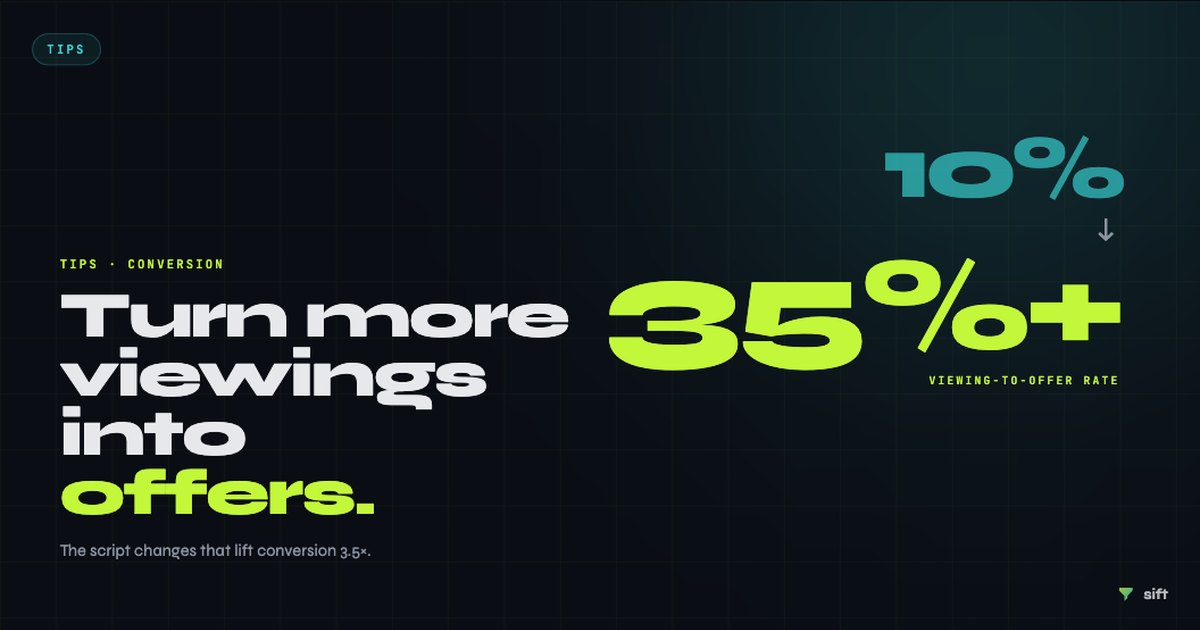
The 35-45% conversion rate isn't achieved by being a better presenter. It's achieved by sending better-prepared buyers to viewings. Pre-qualification is the highest-ROI action between a portal enquiry and a completed sale, and most of it can be automated before your team is even involved.
Sift automates this pre-qualification step on your website. Plans start from £149/month, with a 14-day free trial and no card required.
For a systematic approach to qualifying buyers before they reach your diary, see our guide on how to qualify property buyers in the UK and the qualification questions to ask before booking any viewing.