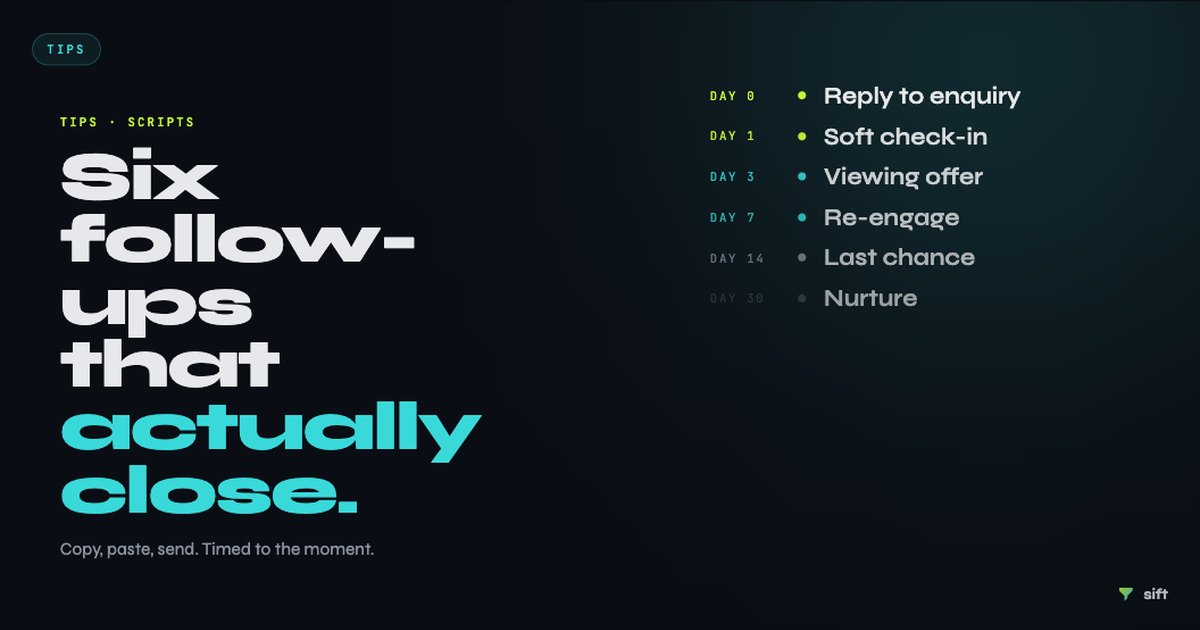
The generic follow-up is one of the most common mistakes in estate agency. A buyer enquires on Thursday. On Friday morning, someone sends: "Hi [Name], just following up to see if you're still interested in [address]? Happy to arrange a viewing at your convenience."
The buyer may well be still interested. But the agent has learned nothing new. They don't know whether this buyer has a DIP, whether they have a property to sell, or whether they're looking to move in four weeks or fourteen months. They've spent time without gaining signal.
The follow-up scripts below are designed differently. Each one advances the conversation, and each one is built around capturing a specific qualification signal (the same structured data an AI lead qualification agent captures automatically). Use them as starting points, adjust the tone to match your agency's voice, but keep the qualifying questions intact.
The rule for every follow-up: By the end of the interaction, you should know something about the buyer that you didn't know before. If you've just confirmed they're still interested, you've done half a job.
Script 1: First response to a portal or website enquiry
When to use: Within 5 minutes of receiving the enquiry, ideally via SMS or the channel the buyer used. This is your fastest qualification touchpoint, the buyer is still in enquiry mode.
The goal here is twofold: acknowledge immediately (before a competitor does) and open the door to a qualification conversation. Keep it short. Don't try to qualify everything in the first message.
SMS
Immediate acknowledgement + qualification opener
SMS
Hi [First Name], thanks for your enquiry about [address / property ref], great choice. I'm [Your Name] from [Agency].
To help me find you the right time slot, a couple of quick questions: are you buying with a mortgage or cash? And do you have a property to sell first? Just helps me prioritise viewing times for you.
Happy to call if easier, what time suits?
Keep it conversational. "Helps me prioritise viewing times for you" frames the question as a benefit to the buyer, not an interrogation.
Email version
Subject: Your enquiry about [address], [Agency Name]
Hi [First Name],
Thanks for your interest in [address], I'd love to arrange a viewing for you.
Before I confirm a slot, it would help me to know a little more about your position so I can make the best use of your time:, Are you buying with a mortgage or as a cash buyer?, Do you have a property to sell, or are you chain-free?, Are you working to a particular timeline?
Just reply here or give me a call on [number], whichever is easier.
[Your Name]
[Agency]
Three questions maximum. More than three and buyers stop reading.
Script 2: Opening a qualification call
When to use: When you're calling a buyer for the first time, either as the first point of contact or after an initial SMS exchange. The first 30 seconds set the frame for the whole call.
Most agents open with "Is now a good time?" and then jump straight to viewing availability. This script opens with a commitment to be helpful, then earns the right to ask qualifying questions.
Phone
First qualification call
Phone script
Hi, is that [First Name]? It's [Your Name] from [Agency], you enquired about [address]. Is this a good moment?
[If yes] Great, I've got some availability to show you, but I want to make sure it's the right fit before we book anything in. Do you mind if I ask a couple of quick questions?
[Ask in natural conversation, not as a checklist:]
"Are you working with a mortgage broker at the moment, or buying cash?" [DIP status]
"Have you got a property to sell, or are you chain-free?" [chain]
"What's drawing you to this area, is it a particular timeline, or more open-ended?" [timeline + motivation]
"Have you instructed a solicitor yet, or is that something you'd be looking to do once you find the right place?" [legal readiness]
[Then move to the viewing:]
"Based on what you've said, I think [property] could work well for you. I've got [time slots], does either of those suit?"
Ask questions in conversation, not as a form. The goal is to build a picture, not tick boxes. If you get resistance to a question, move on, you can pick it up later.
Script 3: 24-hour follow-up for non-responders
When to use: A buyer enquired but didn't respond to your first message. This is a re-engagement script, not a guilt trip. Keep it short and make it easy to reply.
Re-engagement
No response to first contact
SMS
Hi [First Name], [Your Name] from [Agency] again, just wanted to make sure my message didn't get lost. [Property address] is still available and I have a couple of viewing slots this week. Worth a look?
One short paragraph. The question at the end ("Worth a look?") is designed to elicit a yes/no rather than a long response, lower friction, higher reply rate.
Email
Subject: Still interested in [address]?
Hi [First Name],
Just following up on my message from yesterday about [address]. I have viewing availability on [day] and [day], happy to hold one if you'd like to take a look.
Just reply to this email or call me on [number].
[Your Name]
No qualification questions in this script, the buyer hasn't engaged yet. Focus entirely on getting a response. Qualification comes after.
Script 4: Post-viewing follow-up
When to use: Within a few hours of a viewing. This is your best opportunity to understand where the buyer is in their decision, and to capture any qualification signals you didn't get before the viewing.
Post-viewing
Same-day follow-up after a viewing
SMS
Hi [First Name], great to meet you today at [address]. What did you think? Keen to hear your honest reaction while it's fresh, and if it's a contender, I'd like to understand your timeline so I can keep you updated on anything similar coming through.
"Honest reaction" gives buyers permission to say it wasn't right, which is also useful. You want real signal, not polite maybes.
If calling same day
Hi [First Name], it's [Your Name], just wanted to check in after this morning. How did you find it?
[Listen first. Then depending on response:]
[If positive:] "Glad it landed well. Are you in a position to move fairly quickly if you wanted to make an offer, or are you at an earlier stage?" [readiness check]
[If uncertain:] "Totally understood, what would make it a yes for you?" [objection / priority uncovering]
[If negative:] "No problem at all, what was missing? That helps me when I'm looking at what else might suit you." [preference signal for future matching]
Listen more than you talk. This call gives you more useful data than any form, what they loved, what concerned them, and how ready they actually are.
Script 5: Offer readiness check, before you put them to the seller
When to use: A buyer wants to make an offer. Before you present it to the seller, you need to confirm they're genuinely proceedable. This conversation is often skipped, which is why fall-throughs happen.
This isn't about being difficult. It's about protecting your seller relationship, and making sure you're not accepting an offer that collapses six weeks later.
Pre-offer
Readiness verification before accepting
Phone
Hi [First Name], brilliant, I'll put that to the seller. Before I do, can I just run through a couple of things? My sellers always ask and I want to be able to give them the full picture.
"Is your mortgage DIP still current? [If buying with mortgage] When was it issued and with which lender, is it a high-street mortgage or more specialist?" [financial readiness]
"And your property, is it sold subject to contract at the moment, or still on the market?" [chain status]
"Have you got a solicitor ready to instruct? If not, I can recommend a couple of local firms who are good on speed." [legal readiness, offer to help, not interrogate]
"What's your ideal completion date, is there a particular date you're working towards?" [timeline commitment]
Thanks, that's really helpful. I'll call the seller now and come back to you within the hour.
Frame each question as something the seller will ask, which is true. Buyers understand this framing because it's about helping the process, not vetting them.
Script 6: Re-engaging a ghost lead
When to use: A buyer went quiet after some initial engagement, viewing enquiry, viewing completed, or even a conversation about an offer, and you haven't heard from them in 4+ weeks. Don't chase with "just checking in." Give them a reason to re-engage.
Re-activation
Cold lead, 4+ weeks of silence
SMS
Hi [First Name], [Your Name] from [Agency]. We've just had [a new instruction / a price reduction / a similar property] come in that matches what you were looking for in [area]. Worth a look, or has your situation changed?
Give them a concrete reason to respond ("new instruction", "price reduction"). "Has your situation changed?" opens the door to an honest update without pressure.
Email, longer re-engagement
Subject: Something new in [area], thought of you
Hi [First Name],
We spoke a few weeks ago about your search in [area]. I've just had [new instruction description] come on that fits quite closely with what you were describing.
[One sentence description of property, beds, key feature, price]
Are you still actively looking, or has your timeline shifted? Either way, happy to keep you on our list for anything similar.
[Your Name]
[Agency]
[Number]
"Are you still actively looking, or has your timeline shifted?" is a clean disqualification question. If the buyer isn't ready, this response tells you. If they are, it reopens the conversation.
Six follow-up mistakes to stop making
✕
"Just checking in to see if you're still interested." This adds no information. If the buyer is still interested, you haven't learned anything. If they're not, you've wasted a touchpoint that could have disqualified them earlier.
✕
Asking five questions at once. Buyers stop reading after question two. Pick the single most useful question for that stage of the relationship and ask only that.
✕
Following up at the same time every day. If you're calling at 9.30am every morning, the buyer learns to ignore 9.30am calls from your number. Vary the time. Try SMS when calls fail. Try email when SMS fails.
✕
Not recording what you learn. If a buyer tells you they have a DIP with NatWest expiring in August and a flat to sell in Hackney, that information is worthless unless it's in your CRM. Scripts are only as good as your note-taking.
✕
Treating all leads the same after no response. A buyer who viewed twice and went quiet deserves more effort than a buyer who clicked an enquiry button at midnight and never replied. Your follow-up cadence should reflect the buyer's engagement history.
✕
Skipping the offer readiness check. This is the most expensive mistake. Accepting an offer from a buyer who isn't proceedable and then discovering six weeks later that they have no DIP is a problem that could have been caught in a two-minute conversation.
A note on volume
If your agency receives more than 30-40 enquiries a week, running Scripts 1 and 2 manually for every new lead becomes unsustainable. The first response, the most time-sensitive touchpoint in the whole sequence, is the one that gets dropped first when teams are under pressure.
This is the specific problem an AI qualification layer solves. Sift has the Script 1 conversation with every new enquiry automatically, asking about mortgage status, chain position, and timeline within minutes of submission, at any hour. By the time your negotiator makes the Script 2 call, they already have the answers. The human conversation starts at a higher level.
Automate buyer qualification on your website
Sift's AI captures every qualification signal 24/7, before your team starts the working day.
Start Free Trial