Buyers browse Rightmove after dinner. They send enquiries at 9pm on a Tuesday, on Saturday morning while the kids are watching cartoons, on a bank holiday afternoon when a new listing catches their eye. Property search doesn't happen between 9am and 5pm, it happens whenever people have time to think about their lives.
Your office closes at 5:30pm. The enquiry lands. An auto-acknowledgement fires. The buyer moves on. By the time you call the next morning, they've either already booked with a competitor, lost interest, or, most commonly, submitted the same enquiry to three other agents and they'll go with whoever calls first. This is the core problem that AI lead qualification for UK estate agents is designed to solve.
When Enquiries Actually Arrive
The peak hours for Rightmove browsing and enquiry submission are not 10am-3pm. They cluster around commuting times, lunch breaks, and evenings. The hours when most estate agents are least equipped to respond are the hours when most buyers are most active.
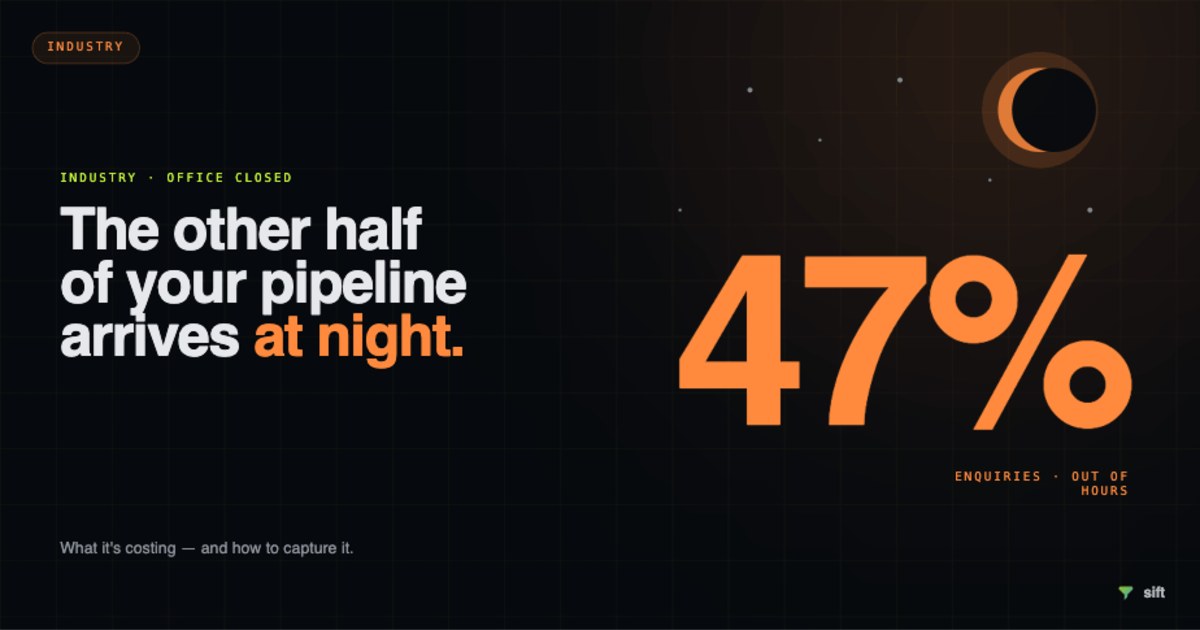
The evening block, 6pm to 10pm, typically accounts for 25-30% of all daily enquiry volume. Add Saturday and Sunday, and you're looking at close to half your weekly enquiries arriving when nobody at your agency is there to respond.
What Happens to Those Enquiries Right Now
Walk through what actually happens when a buyer submits an enquiry at 8:47pm on a Thursday.
Rightmove sends the enquiry to your agency email. An auto-acknowledgement fires: "Thanks for your enquiry. A member of our team will be in touch shortly." The buyer reads it, notes that "shortly" apparently means tomorrow morning at the earliest, and moves on to whatever else they were doing. They may or may not remember submitting the enquiry by the time someone calls them back.
The next morning, the enquiry appears in the office inbox alongside seventeen others. The negotiator who picks it up calls at 9:15am. The buyer is in a meeting. A voicemail is left. No callback arrives. The enquiry gets marked as "tried to contact" and sinks to the bottom of the pile.
Meanwhile, the buyer submitted the same enquiry to two competing agents. One of them has a system. Their buyer hears back at 9:03am. A viewing is booked before lunch. Your enquiry never converts.
The maths on what this costs: If your agency takes 80 enquiries per month and 40% arrive out of hours, that's ~32 enquiries per month arriving overnight or at weekends. If your next-morning contact rate is 60% (typical) and your conversion rate from contact to viewing is 35%, you're booking roughly 7 viewings from those 32 enquiries. Fix the out-of-hours response and get a meaningful reply out within minutes, conversion rate rises to 55-60%. That's 11-12 viewings instead of 7. At a 10% viewing-to-offer rate, that's 1-2 additional offers per month. Across a year, that's 12-24 additional potential completions from a single process change.
How Response Speed Decays
The value of an enquiry is not fixed, it falls rapidly the longer you wait. The buyer who was excited at 8:47pm is a different buyer at 9:15am the next day. They've slept on it. The urgency has faded. They've probably been contacted by someone else.
These numbers illustrate the pattern that research on lead response times consistently shows: the decay isn't gradual. Most of the value is lost in the first hour. Waiting until the next morning doesn't lose you 10% of a lead, it loses you nearly 90% of it.
Four Approaches to Out-of-Hours Coverage
There are four ways estate agencies typically handle out-of-hours enquiries. They vary significantly in cost, quality, and what the buyer actually experiences.
- No cost or setup
- Loses ~89% of lead value
- Buyers go to faster competitors
- No qualification data at all
- Human voice on the line
- Covers phone calls
- £200-£600/mo for most agencies
- Doesn't cover form/portal enquiries
- Message quality varies
- Genuine human response
- Can book viewings immediately
- Staff burnout and resentment
- Expensive in time cost
- Inconsistent quality
- Responds in seconds, any hour
- Qualifies chain, finance, timeline
- Passes structured summary to agent
- No staff cost or rota fatigue
What Buyers Expect When They Enquire at 9pm
Buyer expectations around response times have shifted significantly in the past five years. The Amazon effect, next-day delivery, instant confirmation, real-time tracking, has recalibrated what "reasonable" means. Buyers don't expect a human phone call at 9pm. But they do expect acknowledgement that is more than a generic template.
What a meaningful out-of-hours response looks like:
- Immediate acknowledgement (within 60 seconds of enquiry submission)
- Confirmation of the specific property they enquired about, by address or listing reference
- A question that starts the qualification conversation, not just "we'll be in touch"
- A realistic timeframe for a human to follow up ("a member of our team will call you before 9:30am tomorrow")
- An option to book a viewing or provide more information if they're ready to proceed
When you do this well, the buyer feels attended to. They stop looking for other agents to respond. And when your negotiator calls at 9:15am, they already have context: chain status, deposit confirmed, mortgage approved, viewing preference. The conversation starts three steps further along.
The qualification advantage: An out-of-hours system that captures chain status, deposit size, and mortgage status before office hours means your negotiator's morning call list is already prioritised. You call the proceedable buyer first, the time-waster last, without having to discover which is which during the call.
Building Your Out-of-Hours Response System
Whether you go with an answering service, an AI widget, or a hybrid approach, the same principles apply. A good out-of-hours system needs to do five things reliably.
The Weekend Problem
Weekends are a disproportionate share of the out-of-hours problem. Saturday and Sunday combined often account for 30-35% of weekly enquiry volume, partly because buyers have time, partly because property portals run promotions that drive traffic, and partly because viewing a new listing on a Saturday morning and enquiring immediately is a natural pattern.
Most agencies either have someone covering Saturday (which helps for calls but rarely for after-hours portal enquiries) or are completely closed Sunday. A buyer who enquires at 11am on a Sunday is in the same position as an overnight buyer: they're waiting until Monday morning, their enthusiasm has peaked and is cooling, and whoever calls fastest wins.
The agencies winning the most weekend instructions are the ones who treat Saturday evening and Sunday as a distinct operational problem, not just "office hours, but quieter." They have a specific answer to the question: what happens to a Sunday evening enquiry in my agency?
How Sift Handles the Out-of-Hours Window
Sift (from £149/month) sits on your estate agency website as a chat widget. When a buyer visits at 9pm and asks about a property, Sift starts the conversation immediately, asking the qualifying questions your negotiators would ask, collecting chain status, mortgage position, and timeline in a natural chat format.
By the time your office opens, you have a structured lead summary for every out-of-hours enquiry: who they are, what they're looking for, whether they're proceedable, and whether they want to book a viewing. Your morning call list is pre-sorted by priority. You're starting three steps into the conversation, not cold.
For agents taking 30-120 enquiries per month, this typically means 15-55 additional overnight leads per month that are engaged, qualified, and ready for a morning follow-up instead of sitting unread in an inbox. You don't add headcount. You don't burn out your team with an on-call rota. The leads are handled, every night, without exception.
The gap between agents who handle out-of-hours leads well and those who don't is growing. Buyers increasingly expect immediate engagement. The agents who provide it, who are, in effect, always available even when their office isn't, will convert more of the enquiry volume they're already paying portals to generate.
Related: If your daytime response speed also needs work, read our guide on speed to lead for estate agents, covering why the first agent to respond wins the instruction, and how to build a response protocol that's fast enough to compete.