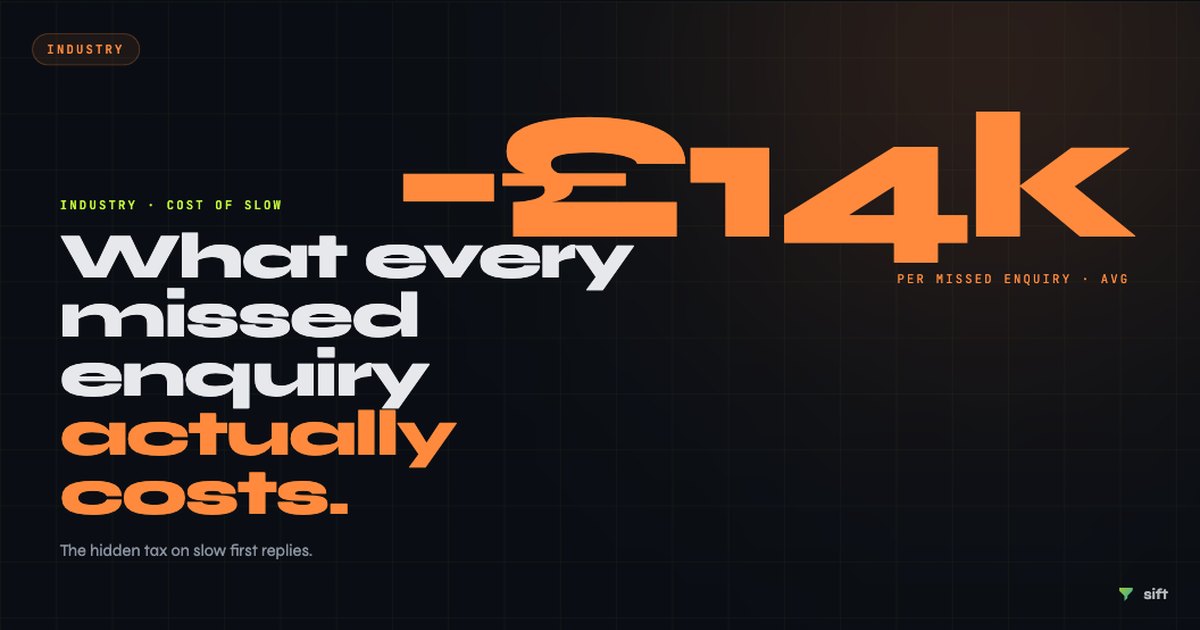
Every estate agent reading this has a number in their head: the enquiries they didn't follow up fast enough. The Saturday evening portal notification that sat in an inbox until Monday morning. The out-of-hours web form that got a response 18 hours later, after the buyer had already booked a viewing with a competing agency.
What most agents don't have is the financial cost of that delay, in pounds, per year, specific to their business. That's what this guide walks through. If you want the wider context, see our overview of AI lead qualification for UK estate agents.
The starting point: UK commission economics
To calculate the cost of a missed enquiry, we need to start with what a converted enquiry is worth.
// Commission per sale, UK benchmarks
For this guide, we'll use £3,000 per completed sale as a conservative benchmark, lower than the mid-market average, but representative of a typical instruction. Apply your own rate to the calculations below.
The response gap: what the data shows
The Alto Agency Trends Report 2026 (survey of 250 UK estate agents) found that the industry collectively misses over £119 million in revenue annually from enquiries that fail to convert, primarily due to response time. Three numbers drive most of that loss:
Read those together: nearly half of your enquiries arrive when nobody is there to answer them, and the vast majority of those enquiries are never followed up. The ones that do get a follow-up wait over half a day for it.
In a market where the first agent to respond wins the buyer's attention, this is not a minor inefficiency. It's a systematic revenue drain that compounds every week.
The calculation: your annual cost
Let's run the numbers for three typical UK agency sizes. You can apply the same formula to your own enquiry volume.
The formula has four steps:
- Total monthly enquiries: from portals, website, and direct contact
- Out-of-hours volume: typically 40% of total
- Abandoned enquiries: 85% of out-of-hours that never convert
- Lost commission: abandoned leads × your typical conversion rate × commission per sale
We use a conversion rate of 8% (enquiry to completed sale) as the baseline: conservative relative to qualified buyers, realistic when including the full mix of casual browsers, serious buyers, and everyone in between.
These are lost commission figures: revenue that arrived at your door, expressed interest in a property you represent, and then walked away because nobody replied in time.
Run your own calculation: Take your monthly enquiry volume. Multiply by 0.40 (out-of-hours share). Multiply by 0.85 (abandonment rate). Multiply by 0.08 (conversion rate). Multiply by your average commission per sale. That's your monthly loss. Multiply by 12 for the annual figure.
Why the standard responses don't solve it
Most agencies already know about the response gap. The reasons it hasn't been fixed say more about the available solutions than the agents:
Portal auto-acknowledgements
Every major portal (Rightmove, Zoopla, OnTheMarket) sends an automatic "we've received your enquiry" message. Buyers know these are automated. They don't satisfy curiosity about a specific property. They don't qualify the buyer. And they don't prevent the buyer from sending the same enquiry to the next three listings while they wait for a real response.
Call forwarding to mobiles
Forwarding the office phone to a personal mobile asks your negotiators to be on-call evenings and weekends indefinitely. Most agents try this, most stop within a few weeks. It erodes work-life boundaries, call quality suffers (background noise, distracted agent), and it doesn't scale to high-volume periods.
Out-of-hours answering services
Third-party call handling costs £200 to £800/month for a small agency and delivers a message-taking service, not qualification. The buyer gets a "someone will call you back" response. That's marginally better than an auto-email, but it doesn't capture chain status, DIP status, or any of the signals that determine whether a viewing is worth booking.
Hiring for evenings and weekends
A part-time negotiator for evenings and weekends costs £15,000 to £22,000 per year in salary, plus NI, pension, and management overhead. They cover perhaps 30 hours per week, leaving bank holidays, illness, and the middle of the night uncovered. And a human negotiator doing five calls per hour can't scale during peak portal notification windows.
What changes the economics
The problem with all of the above is that they're human-staffing solutions to a volume-and-timing problem. The enquiry arrives at 10:43pm on a Sunday. There is no cost-effective human solution for that moment.
An AI qualification layer changes the unit economics fundamentally:
- Covers ~30 hrs/week only
- No overnight or bank holiday cover
- Variable quality and consistency
- Doesn't scale in high-volume windows
- Message-taking only
- No buyer qualification
- Buyer still waits for callback
- No lead scoring output
- Responds instantly, 24/7/365
- Qualifies fully: chain, DIP, budget, timeline
- Delivers scored lead to your dashboard by morning
- No volume ceiling: handles peaks automatically
The ROI calculation
Let's use the small agency scenario (30 enquiries/month, £46,800 in annual lost commission) and apply Sift's Growth plan (£299/month = £3,588/year):
// ROI for a small agency, Sift Growth plan
That's a conservative scenario: 25% capture of abandoned leads, at the lowest conversion assumption. If Sift captures 50% of out-of-hours enquiries that would otherwise be abandoned (which is achievable given it responds instantly with a full qualification conversation), the net gain scales proportionally. Sift starts from £149/month with a 14-day free trial and no card required.
The cost question isn't "can we afford Sift?" It's "can we afford 15 hours of silence every time a buyer enquires out of hours?"
What "capturing" an enquiry actually means
The calculation above assumes Sift helps recover a percentage of abandoned enquiries. It's worth being specific about what that looks like in practice:
- A buyer fills in your website contact form at 9:47pm on a Thursday.
- Sift's chat widget engages them immediately, within seconds, with a conversational response that asks about the property they're interested in.
- Over the next 5 to 10 minutes, Sift asks about chain status, whether they have a Decision in Principle, their timeline, and their confirmed budget range.
- The buyer, who expected a delay, is impressed by the immediate engagement and completes the conversation.
- By the time your team arrives Friday morning, they have a lead record in the Sift dashboard with a lead score between 0 and 100, a complete qualification summary, and a transcript of the conversation (export via CSV on every plan; on Growth and Scale, route to any system via Zapier, webhook, or the REST API).
- A Hot-scored buyer (66+) is prioritised for an 8am callback. A Warm buyer goes into the day's follow-up queue. A Cold buyer is noted and deprioritised.
The buyer who would have submitted the same enquiry to two competing agencies while waiting for your Monday response has instead received immediate attention, and is more likely to book with you specifically.
Measuring your own response gap
Before investing in any solution, run a 30-day audit of your own enquiry data. Most CRMs capture the timestamp of incoming enquiries. Compare that against first outbound contact time and you'll have your own response gap figure.
Most agents who run this audit for the first time are surprised by metric 02: the "no contact within 24 hours" figure is consistently higher than expected. Portals don't track whether the agent called; they track whether the enquiry was sent. That gap in visibility is part of why the problem persists.
The compounding effect
One more dimension that the annual calculation above understates: missed enquiries compound over time.
A buyer who enquires at 10pm, hears nothing until Monday, and books a viewing elsewhere doesn't just represent one lost sale. They may:
- Leave a Trustpilot or Google review mentioning the slow response
- Tell friends or colleagues who are also searching in your area
- Instruct a different agent when they come to sell their own property
- Represent multiple transactions over their lifetime as a property buyer
The initial £3,000 commission is the minimum unit. The reputational and lifetime-value cost can be a multiple of that.
The bottom line
For a typical UK estate agency handling 60 enquiries per month, the annual cost of the out-of-hours response gap is approximately £93,600 in lost commission. That number rises steeply with enquiry volume.
The fix doesn't require hiring more staff or being permanently on-call. It requires a qualification layer that responds instantly at any hour, captures the buyer's details and financial position, and delivers a scored lead record to your team by the time they arrive in the morning.
At £149 to £299/month, the payback period is typically under four months, even on conservative capture assumptions.
What to do next: Run the response gap audit for your own agency (see metrics above). Calculate your own number using the formula: monthly enquiries × 0.40 × 0.85 × conversion rate × commission per sale × 12. Then consider whether a 14-day free trial of Sift is worth running before you know the answer.