If you've started looking at chatbots for your estate agency website, you've probably encountered two things: a lot of tools claiming to be "AI-powered," and very little explanation of what any of them actually do.
The gap between a generic chatbot and an AI lead qualification agent is significant, and it matters more in property than almost any other sector. This guide explains the difference, what a good estate agent chatbot should do, what GDPR requires, and what to look for before you commit. Sift is a purpose-built example: view pricing, from £149/month with a 14-day free trial.
What is an estate agent chatbot?
An estate agent chatbot is software that sits on your agency website and converses with visitors automatically, answering questions, capturing contact details, and (in better implementations) qualifying enquiries before your team sees them.
The term covers a wide range of products:
- Basic live chat widgets, Tawk.to, Intercom, Drift. Show a "chat with us" button. Someone types in, a human responds. Not automated, not AI.
- FAQ bots, scripted flowchart bots that answer preset questions. "What are your opening hours?" "Can I book a valuation?" Useful for admin deflection, not for lead qualification.
- General-purpose AI chatbots, GPT-based tools you can train on your website content. They'll answer questions about your listings and services, but they don't ask the specific questions that UK property negotiators need answered before booking a viewing.
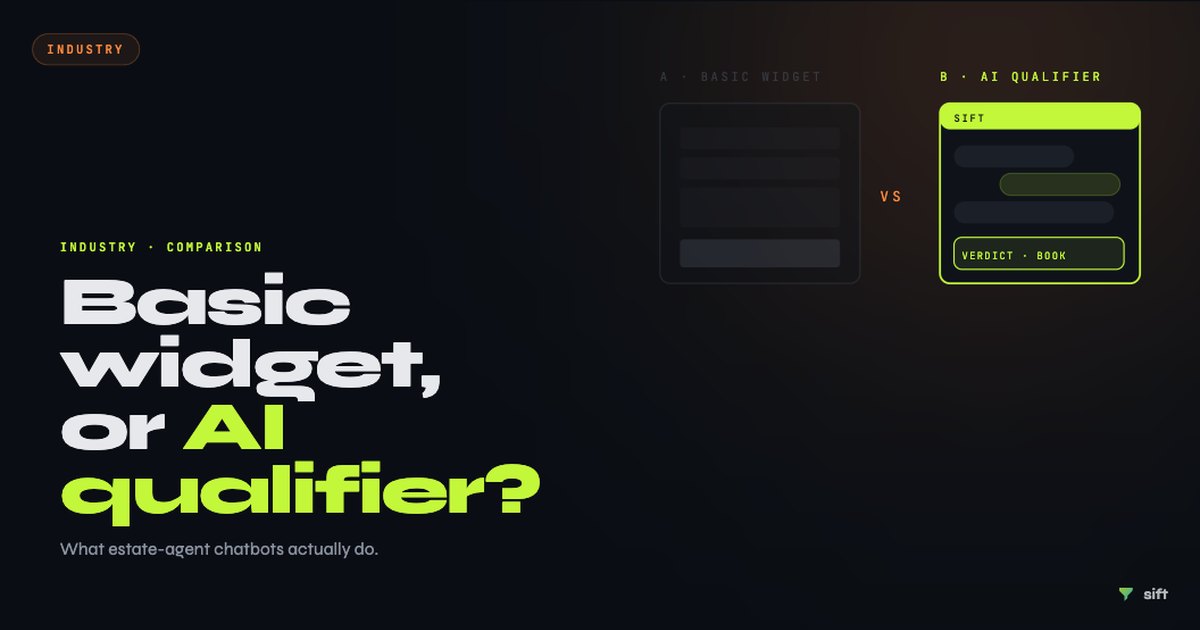
- AI lead qualification agents, purpose-built for property. They conduct a structured qualification conversation with every inbound buyer, capture chain status, mortgage readiness, buyer scheme, and timeline, then score and rank the lead before passing it to your team.
Most agencies searching for a "chatbot" end up with something from the first three categories. What actually moves the needle in UK property is the fourth.
Why generic chatbots underperform in estate agency
Generic chatbots aren't built around the information that actually matters in UK residential property. They don't know what a Decision in Principle is. They can't distinguish between a cash buyer who has immediate funds and a "cash buyer" who is conditional on selling their current home. They don't handle Help to Buy, Shared Ownership, or First Homes schemes.
Generic chatbot
- Collects name, email, phone number
- Answers FAQ questions
- Passes all enquiries to your team equally
- No lead scoring or ranking
- No UK qualification signals
- US-centric terminology (pre-approval, not DIP)
AI qualification agent
- Asks chain status, DIP, buyer scheme
- Distinguishes cash types correctly
- Scores and ranks every lead 0-100
- Structured lead data, CSV export plus Zapier, webhook, or REST API routing
- Captures GDPR consent with audit trail
- Built around UK residential signals
The result of a generic chatbot is an inbox full of "interested buyers" with no signal on whether any of them are actually ready to proceed. The result of a qualification agent is a ranked list, hot leads first, with the information your negotiators need before they pick up the phone.
The 5 jobs a good estate agent chatbot should do
-
Respond instantly, any time of day 40% of buyer enquiries arrive outside office hours (Moneypenny, 2025). A chatbot that only operates 9-5 isn't solving the problem. The whole point is covering the gap your team can't cover, evenings, weekends, bank holidays.
-
Ask the right qualifying questions For UK residential property, that means chain status, mortgage readiness (DIP/AIP status, not just "have you spoken to a mortgage broker"), cash buyer type, government scheme eligibility, confirmed budget, and search timeline. A chatbot that doesn't ask these questions isn't qualifying, it's just taking a message.
-
Capture GDPR consent before any personal data is recorded You cannot collect names, emails, or phone numbers from website visitors without a lawful basis. For lead generation via chat, that means explicit consent, captured before the conversation continues, with a timestamp and the exact consent text stored. A chatbot that doesn't handle this is creating compliance risk. More on this in the GDPR section below.
-
Score and rank the lead Not all buyers are equal. A chain-free buyer with a DIP in hand and a 4-week search timeline is categorically different from a buyer who hasn't started their mortgage application and is "just looking." A chatbot should assign a score to each lead and surface the hot ones first so your team doesn't have to manually triage.
-
Push structured data to your CRM Conversation transcripts in a separate inbox are not useful. The qualified data, chain status, DIP status, buyer scheme, timeline, score, should arrive in your CRM as structured fields your team can filter, sort, and act on. If you have to copy-paste from a chat window into your CRM, the chatbot isn't integrated, it's just adding a step.
What an estate agent chatbot should not do
There are a few chatbot behaviours that create problems rather than solving them.
Pretend to be a human
Some chatbots are designed to impersonate named members of staff, "Hi, I'm Sarah from the lettings team." Under the ICO's guidance on AI and transparency, automated systems that could mislead a user about whether they're talking to a human are problematic. The better approach is to be clear the user is talking to an AI assistant, which most buyers accept without issue.
Collect data without a lawful basis
This is the most common compliance mistake. See the GDPR section below for what's required.
Ask too many questions at once
Qualification should feel like a conversation, not a form. Asking eight questions in sequence ("What's your budget? What's your timeline? Have you sold your property?") produces the same drop-off rate as a long form, sometimes worse, because the chat interface creates an expectation of a natural exchange. A good AI qualification agent asks questions naturally across a conversational flow, not in a list.
Qualify without context
UK property has specific signal types that don't exist in other markets. A chatbot trained on US real estate data will ask about "pre-approval" (the American equivalent of a DIP), miss Help to Buy and Shared Ownership schemes entirely, and misclassify cash buyers. UK residential property requires UK-specific qualification logic.
Estate agent chatbots and GDPR
Any chatbot that collects personal data from UK website visitors is subject to UK GDPR. This means you need a lawful basis to collect it, an appropriate privacy notice, and in most cases, for a lead generation use case, explicit consent.
What ICO-compliant consent for a chatbot looks like: Before any personal data is collected, the user sees a clear statement explaining what data will be collected and why, and actively confirms they consent. The consent timestamp and exact consent text are stored as a record. The user can withdraw consent and request erasure of their data.
Several additional requirements apply when you're using AI to process lead data:
- Data Processing Agreement (DPA). If you use a third-party chatbot tool, you need a DPA with them. They are a data processor acting on your behalf, and under Article 28 UK GDPR, you're required to have a written contract that specifies what data is processed and how.
- Data residency. UK GDPR restricts international transfers of personal data. A chatbot that processes your leads on US infrastructure may require additional safeguards (Standard Contractual Clauses or equivalent).
- Automated decision-making. If your chatbot's lead scoring results in a buyer being automatically excluded from follow-up with no human review, that could trigger Article 22 of UK GDPR (rights related to automated decision-making). In practice, most chatbots are used to prioritise rather than exclude, which is lower risk, but it's worth understanding where your workflow sits.
- Model training. If a chatbot provider uses your leads' data to train or improve their AI models, that requires a separate lawful basis. Check the terms before you sign up.
The chatbot tools most likely to create compliance problems: US-based general-purpose AI tools with no UK GDPR awareness, no DPA available, and data processed on American servers. These are common in the "AI chatbot" space but not built for UK property compliance requirements.
For a deeper dive on this topic, read our full guide to GDPR compliance for estate agents.
How to choose an estate agent chatbot: 5 criteria
Does it ask UK-specific qualification questions?
Not "have you spoken to a mortgage broker?" but "do you have a Decision in Principle?" Not "are you a cash buyer?" but a follow-up to confirm whether funds are available immediately or conditional on a sale. Not "what government scheme are you on?" but specific options for Help to Buy, Shared Ownership, First Homes, and standard purchase. If the chatbot doesn't know what a DIP is, it's not built for UK residential.
Does it include GDPR consent capture?
This should be non-negotiable. The consent gate needs to appear before any personal data is collected, store the exact consent text and timestamp, and allow for subject access requests and erasure. Ask specifically: "Do you provide a Data Processing Agreement?" If the answer is no or unclear, move on.
Does it score and rank leads, not just collect them?
The output of a qualification chatbot should be a ranked list of leads, not a flat inbox. You want to open your CRM each morning to a call list sorted by lead score, hot leads first. If the chatbot just emails you a transcript, it hasn't done the work.
Does it integrate with your CRM?
Look for CRM integration via webhook or API, structured data (chain status, DIP, buyer scheme, timeline, score) pushed directly into contact records, not just a transcript sent to your inbox. Check which CRMs are supported: Alto, Reapit, Rex, Dezrez, Loop, and Street are the main UK residential platforms.
Is setup genuinely quick?
The barrier to getting a chatbot live should be low. A single embed script on your agency website (paste and publish, no developer needed) for the widget, plus a 30-minute webhook setup to connect to your CRM. If the vendor is telling you it's a multi-week implementation, the product either has too many moving parts or requires too much customisation to function as advertised.
What does a typical chatbot conversation look like?
Here's a simplified example of how an AI qualification chatbot should handle an inbound buyer enquiry:
Buyer: Hi, I'm interested in the 3-bed semi on Oak Road, could you tell me more about it?
Sift: Hi! Happy to help. Before I go any further, I just want to confirm, is it okay if I ask a few quick questions so we can make sure it's the right fit? [Consent gate shown]
Buyer: Yes, no problem.
Sift: Great. Are you currently renting, or do you have a property to sell?
Buyer: I own a flat but I haven't put it on the market yet.
Sift: Got it, so you'd be in a chain. Have you had your flat valued yet?
Buyer: Yes, got a valuation last week.
Sift: Good, that's the first step. Have you spoken to a mortgage adviser and got a Decision in Principle for the purchase?
Buyer: Yes, I've got a DIP from Nationwide for up to £380k.
Sift: Perfect. And roughly when are you looking to move?
By the end of a two-minute conversation, the agent has: chain status (in chain, unsold property), mortgage readiness (DIP confirmed, £380k ceiling), budget, and timeline, before a single human from your team has been involved. That buyer gets scored and lands in the Sift dashboard as a Warm lead (in chain but DIP-confirmed), exportable via CSV on every plan, or routed via Zapier, webhook, or REST API on Growth and Scale. Your negotiator calls them knowing what to discuss.
That's the difference between a chatbot that collects enquiries and one that qualifies them.
Getting started
If you're evaluating estate agent chatbots, the process should be straightforward:
- Trial the product directly, any serious vendor should offer a free trial without requiring a call with a salesperson first. You should be able to see the qualification flow and the lead dashboard before you commit.
- Test the qualification conversation, go through the chat as a buyer would. Does it ask about chain status? Does it correctly handle DIP? Does it distinguish between genuine cash buyers and conditional ones? If not, it's not fit for purpose.
- Check the GDPR documentation, ask for the Data Processing Agreement and check the data residency situation. This is a legal requirement, not a nice-to-have.
- Try the CRM integration, ask whether your CRM is supported and request a demo of what data lands in the contact record after a qualification conversation.
- Measure a baseline first, before you switch anything on, note your current lead-to-viewing conversion rate and average response time. Four to eight weeks after launch, compare. The metric that usually moves fastest is out-of-hours enquiry capture.
What to expect from a 14-day trial: You should be able to install the widget, run through the qualification flow yourself, receive a scored lead in your dashboard, and see what the CSV export, or, on Growth and Scale, a Zapier or webhook payload, looks like. All within the trial period. If a vendor needs more than a week to get you to that point, the product isn't as turnkey as advertised.
The bottom line
An estate agent chatbot is worth having if, and only if, it does the job your team can't do at scale: asking the right qualification questions at any hour, scoring every lead, and surfacing the hot ones first. A generic chatbot that collects contact details and forwards them to your inbox isn't solving the problem. It's adding a step.
The qualification questions that matter in UK residential property are specific: chain status, DIP/AIP, cash buyer type, government scheme, confirmed budget, timeline. A chatbot that doesn't know what a DIP is, can't handle Help to Buy, and doesn't score leads against these signals won't improve your conversion rate, it'll just add noise to your inbox.
If you're ready to see what AI lead qualification looks like in practice, Sift installs in under 10 minutes and offers a 14-day free trial with no card required.