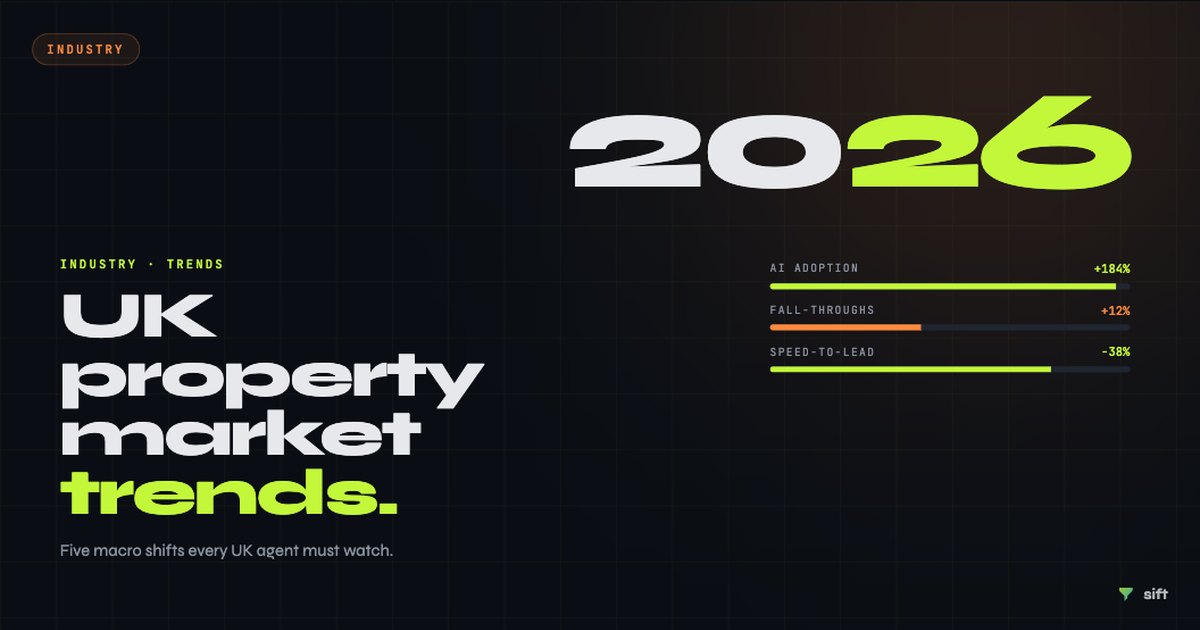
2026 is shaping up to be one of the most consequential years for UK estate agents in a decade. Three regulatory shifts, one accelerating technology wave, and a buyer-behaviour change that was quietly building for years have all converged at once. Here's what's happening and what it means for your agency. For the lead qualification dimension specifically, read our guide to AI lead qualification for UK estate agents.
1. The AI adoption divide is becoming a competitive divide
The Alto 2026 Agency Trends Report, based on responses from 250 UK estate and letting professionals, found that 52% of agents plan to adopt AI tools for listings, lead generation, and marketing in the next 12 months. Among larger agencies, that figure approaches 90%.
"Agents are drowning in compliance checks, data entry and repetitive tasks."
, Alto 2026 Agency Trends Report
But roughly a third of agents, skewed toward independents, remain "nervous" or "unsure." This hesitation creates a straightforward competitive dynamic: the agencies adopting AI first are building a speed and capacity advantage over the agencies that aren't. That advantage compounds. An agency that can respond to 100% of out-of-hours enquiries beats one that responds to 60%, every time.
The hesitation among independents is understandable, many AI tools are designed for large teams or US markets and don't translate. But the tools that are purpose-built for UK estate agents are arriving, and the window for early-mover advantage is real.
2. Speed-to-lead is now a frontline metric
In 2024, "speed-to-lead" was a concept. In 2026, it's a number being tracked in dashboards. 40% of buyer enquiries now arrive outside normal office hours (Moneypenny, 2025). Businesses lose up to 40% of potential leads to slow response times (Cymphony), and in property, that rate is even higher because urgency drives behaviour.
When a buyer finds a listing at 9pm and can't get a response, they don't wait. They contact the next agent on their shortlist. The £119 million lost annually by UK estate agents to missed calls captures just the phone channel, the total when email and web enquiries are included is likely higher.
The agencies winning on speed-to-lead in 2026 are the ones with some form of automated first response that's substantive enough to hold the buyer's attention until a human can follow up. A confirmation email that arrives 12 hours later is not competitive. An AI that qualifies the buyer's position in the first five minutes, chain status, DIP, timeline, and confirms next steps is.
3. Compliance is shifting from defensive to offensive
The same Alto survey found that 66% of agents plan to use AI specifically for compliance and AML automation. This is the under-discussed story of AI adoption in UK property: it's not just about growth, it's about regulatory survival.
The ICO has been increasingly active in enforcing against estate agents who capture personal data without proper consent, something that happens constantly via property enquiry forms that don't gate on GDPR consent. Agents who get this wrong face fines and reputational damage. Agents who get it right have an asset: a compliant, auditable data capture process that they can point to in conversations with regulators, vendors, and buyers.
The compliance angle is also a sales angle. UK estate agents who can say "our AI qualification system captures consent before any personal data is stored, with a full audit trail" are selling a meaningful differentiator to vendors and landlords who've seen the consequences of data breaches at other agencies.
4. The Renters' Rights Act 2026 is reshaping the lettings market
The Renters' Rights Act, the most significant reform to UK lettings law in thirty years, is in force in 2026. For lettings agents, the practical implications are significant:
- Section 21 "no fault" evictions are abolished, landlords must now rely on specific grounds
- Tenancy agreements are now periodic by default, no more fixed-term ASTs at the outset
- New decent homes standards for the private rented sector
- A private rented sector database that landlords and agents must register with
For lettings agencies, this means more compliance work, more documentation, and more complex conversations with landlords about their options. For sales agencies, it means some landlords will exit the market, converting buy-to-let stock into sales listings and creating a supply injection in certain areas.
The agencies building durable advantage here are those that are positioning themselves as compliance-competent, not just in their own data handling, but as advisors to landlords navigating the new landscape.
5. Platform-native AI is arriving, but it's CRM-locked
Alto's Lead Flow (powered by BridgeAI), launched in April 2026, provides 24/7 inbound qualification and viewing booking for Alto CRM users. Reapit's "RAI" assistant is rolling out a viewing module and applicant entry features through summer 2026. Street.co.uk's Cortex product handles AI-driven outbound email nurture and auto-reply for Street CRM users.
This is good news for the market overall, it validates the use case. But every one of these tools is CRM-locked. None of them works for agencies on Dezrez or Loop. None of them works for an independent agency that uses a bespoke website and sends leads to their own CRM via webhook.
The agencies that benefit most from platform-native AI are those already on the major CRM platforms. The agencies on smaller or independent setups, and there are thousands of them across the UK, need tools that work with any CRM and focus on the problem that no CRM-native tool addresses: qualifying anonymous website visitors before they've ever touched a CRM record at all.
What 2026 means in practice
For most estate agents, these five trends converge on a single practical question: are you able to respond to every enquiry, at any hour, with a qualification process that's fast, UK-specific, and GDPR-compliant?
The agencies that can will win a disproportionate share of the serious buyers who are, in 2026, more likely than ever to make enquiries out of hours, more likely to research compliance before submitting data, and more likely to view speed-to-lead as a signal of agency quality.
The agencies that can't will continue to lose approximately a third of their leads to slow response times, leads that are, in the current market, going to the next agent on the shortlist within minutes. Sift closes that response gap with 24/7 AI qualification from your website. Plans from £149/month.