Most estate agency lead scoring is just a pile of activity data: how many times a lead has viewed a listing, whether they opened your email, how quickly they responded. These signals tell you something about engagement, but almost nothing about proceedability.
In UK property, proceedability is everything. A highly engaged buyer who is chain-dependent, has no DIP, and won't commit to a timeline is less valuable than a quiet first-time buyer who is chain-free with a DIP in hand. Activity scoring penalises the second buyer. Proceedability scoring rewards them.
This guide builds a UK-specific lead scoring model from the ground up: which signals to capture, how to weight them, how to set tier thresholds, and what the score should change about your follow-up process.
Lead scoring vs lead qualification: what's the difference?
Qualification is binary, it answers "is this lead worth pursuing at all?" Scoring is continuous, it answers "among leads worth pursuing, which should I call first?" You need both, but they serve different purposes. Our guide to AI lead qualification for UK estate agents covers the qualification layer in detail.
A typical UK agency workflow should run qualification first (does this buyer have a realistic budget and a plausible timeline?), then scoring (given they're qualified, how strong are the proceedability signals?). This guide focuses on scoring, how to rank qualified leads against each other.
The six signals that drive UK lead scores
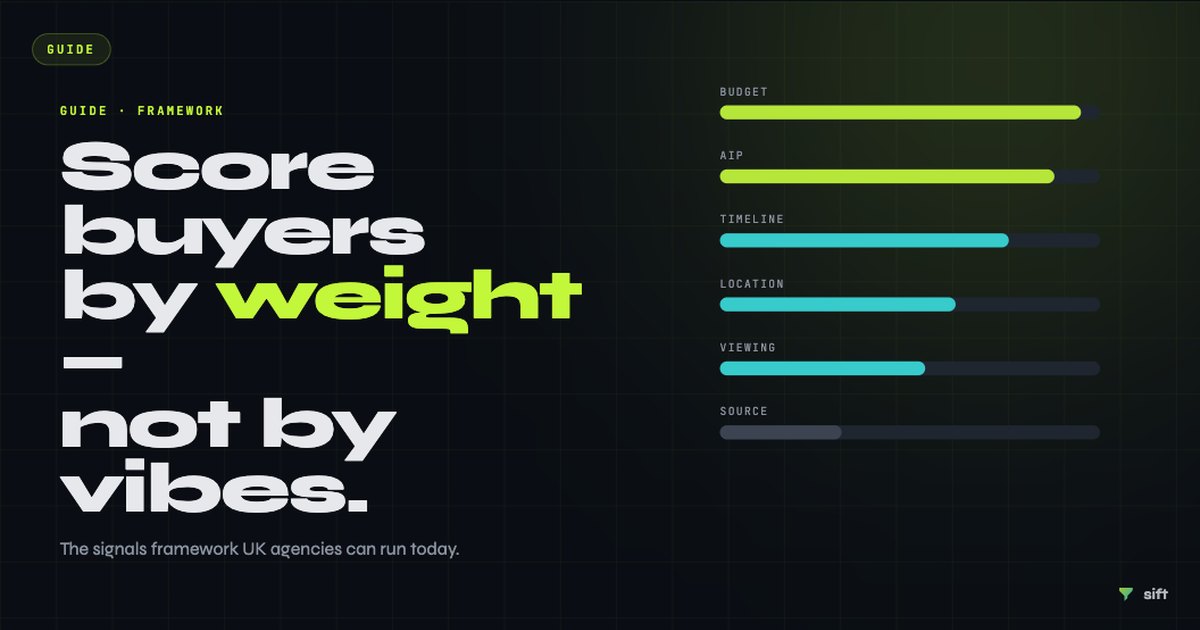
These are the signals that most reliably predict whether a lead will transact, and how fast. Each has a suggested point value based on its correlation with deal progression speed in a UK residential context.
Signal 1: Chain status
Chain status is the single biggest predictor of transaction speed. A chain-free buyer can exchange in weeks. A buyer in a chain of four can take months, or collapse entirely if any link breaks.
| Chain status | Score | Why |
|---|---|---|
| Chain-free (FTB, renter, or sold STC) | +18 | Fastest path to exchange; no dependency on other transactions |
| Sold STC (under offer on own property) | +10 | Good signal but dependent on that transaction completing |
| Not yet on market / currently on market | +3 | Active buyer but chain not yet resolved |
| Unknown / not asked | 0 | Score withheld until clarified |
Signal 2: Mortgage / funding status
The UK-specific distinction here is the Decision in Principle (DIP), also called an Agreement in Principle (AIP). Having a DIP means a lender has done a soft credit check and confirmed they'd lend. It's a materially different signal from "I've spoken to a mortgage broker."
| Mortgage status | Score | Why |
|---|---|---|
| Cash buyer (verified proof of funds) | +20 | No mortgage risk; fastest possible completion |
| DIP / AIP obtained from lender | +14 | Lender commitment in writing; can be communicated to vendor |
| Mortgage needed, in application | +7 | Active process; 4-8 weeks to offer |
| Cash subject to property sale | +6 | Cash in name only; same chain risk as mortgaged buyer |
| Mortgage needed, not started | +2 | Early stage; significant timeline uncertainty |
The cash buyer trap: "Cash buyer" should never be scored without disambiguation. A buyer saying "I'm a cash buyer" requires one follow-up: "Are those funds available now, or do they depend on selling your current home or another event?" Unverified cash scores 0, not +20.
Signal 3: Budget (confirmed vs stated)
There's a meaningful difference between a budget number backed by a DIP and a number a buyer thinks they can afford. DIP-confirmed budgets score higher because they've passed a lender's credit assessment.
| Budget signal | Score | Why |
|---|---|---|
| DIP-confirmed maximum (matches search range) | +10 | Lender-validated; realistic ceiling |
| Stated budget (within 10% of DIP range) | +7 | Plausible; likely to be confirmed |
| Aspirational budget (significantly above DIP range or unverified) | +2 | Risk of wasted viewings on unaffordable properties |
Signal 4: Timeline
Timeline tells you how urgently to prioritise follow-up, not how proceedable the lead is. A buyer who wants to move in four weeks but has no DIP and a broken chain is not actually a four-week buyer. Weight timeline lower than proceedability signals.
| Timeline | Score | Why |
|---|---|---|
| Active, wants to move within 4 weeks | +8 | Urgent but must be validated against proceedability |
| Soon, 1 to 3 months | +5 | Short-term enough to prioritise |
| Planning, 3 to 6 months | +2 | Worth nurturing; not urgent |
| Just looking / no timeline | 0 | Low priority follow-up; add to nurture sequence |
Signal 5: Government scheme eligibility
Buyers using Help to Buy, Shared Ownership, or First Homes have additional eligibility steps that can add weeks or months to a timeline. Score these leads slightly lower than otherwise equivalent leads, not because they're less serious, but because the scheme introduces variables outside your control.
| Scheme status | Score | Why |
|---|---|---|
| No scheme, standard purchase | +5 | Straightforward path to exchange |
| First Homes or Shared Ownership (eligible confirmed) | +4 | Scheme introduces eligibility steps but buyer is committed |
| Help to Buy (legacy equity loan) | +3 | Legacy scheme, very limited new availability |
| Scheme eligibility unknown | +2 | Clarify before first viewing |
Signal 6: Stamp duty position
First-time buyers benefit from stamp duty relief up to £425,000, this can be a genuine motivating factor and a proceedability signal. Second-home buyers face a 3% surcharge, which can affect speed if they need to synchronise a purchase with a sale.
| Stamp duty position | Score | Why |
|---|---|---|
| First-time buyer (FTB relief applies) | +5 | Tax incentive to move; typically motivated buyers |
| Main residence replacement | +3 | Standard purchase; no surcharge |
| Second home / buy-to-let (3% surcharge) | +1 | Higher upfront cost; may be more considered/slower |
Score tiers: what the number means
Once you have a composite score, you need thresholds that translate the number into action. Here's a practical three-tier system:
These thresholds assume a maximum possible score of around 71 for the framework above (18 + 20 + 10 + 8 + 5 + 5 = 66 for an ideal lead, plus some variance). Adjust your thresholds if you modify signal weights.
A worked example
Lead profile: Sarah, 32. First-time buyer. Renting in Manchester, budget £280,000. Contacted via website chat at 8pm on a Tuesday.
- Chain status: Renting, chain-free → +18
- Mortgage status: DIP obtained from NatWest for £265,000 → +14
- Budget: £280,000 stated, £265,000 DIP-confirmed, within 10% → +7
- Timeline: Looking to move in 6-8 weeks → +8
- Scheme: No scheme, standard purchase → +5
- Stamp duty: FTB relief applies → +5
Total score: 57: Warm tier. She has strong proceedability signals (chain-free, DIP obtained) but her DIP is £15,000 below her stated budget and her timeline is slightly optimistic for most completions. Prioritise a same-day call to discuss realistic stock and manage expectations.
What most agencies get wrong about lead scoring
Scoring on activity instead of proceedability. Rightmove saves, portal enquiry counts, and email opens tell you about engagement, not about whether a lead can actually buy. Weight engagement signals at 20% at most; weight proceedability signals at 80%.
Treating the initial score as final. A lead who scores 22 today might score 58 in three weeks after receiving a DIP. Your scoring model should be updatable, every new piece of information should revise the score. Don't archive cold leads after one call.
Not scoring out-of-hours enquiries at all. 40% of UK buyer enquiries arrive outside office hours (Moneypenny, 2025). If your scoring only happens when a negotiator picks up the phone, you're leaving nearly half your leads unscored until the next morning, by which time the lead may have moved on.
Using the same scoring model for sales and lettings. Lettings leads score on different signals: rent-to-income ratio, references status, move-in urgency, whether the applicant is applying alone or with a guarantor. A shared scoring model produces noise in both pipelines.
How AI changes lead scoring
The main constraint on manual lead scoring is that it requires a conversation. A negotiator has to ask the qualifying questions, get the answers, and then, in theory, update the score in the CRM. In practice, they often don't: the score gets estimated from incomplete information, or it never gets updated after the initial call.
AI qualification changes this in two ways. First, it moves scoring to the front of the funnel, before the negotiator picks up the phone, the AI has already asked six qualifying questions and assigned a composite score. Second, it covers out-of-hours enquiries automatically, so the 40% of leads who enquire at 9pm arrive in your morning briefing pre-scored rather than as an undifferentiated inbox.
The result isn't that AI replaces the negotiator's judgement, it's that the negotiator starts every conversation with a scoring summary, rather than needing to discover the score during the call itself.
"Sift scored 47 leads overnight for us last month. By 9am we had a ranked call list. We used to spend the first hour of the day figuring out who to call."
If you want to see how automated scoring works in practice, Sift's free trial includes the full UK qualification model, chain status, DIP/AIP, cash buyer disambiguation, buyer scheme, budget, and timeline, with a composite score recorded against every lead in the Sift dashboard, exportable via CSV on every plan and routable into any CRM via Zapier, webhook or the REST API on Growth and Scale. Plans start from £149/month with no card required for the trial.
Building your own scoring model
The weights in this guide are starting points, they reflect the average correlation between each signal and transaction speed across the UK residential market. Your local market may have different dynamics:
- In a highly competitive market with fast-selling stock, weight timeline more heavily and be aggressive about calling hot leads
- In a slower market, DIP status and chain clarity matter more than urgency, leads may wait months but still transact
- For new-build sales, buyer scheme eligibility may warrant higher weight, FTB incentives often drive 30-40% of new-build buyers
- For leasehold or shared ownership stock, service charge affordability should be an additional qualifying question
The most important thing is consistency: whatever weights you choose, apply them uniformly across every lead so your score is a reliable ranking signal rather than a per-negotiator estimate.