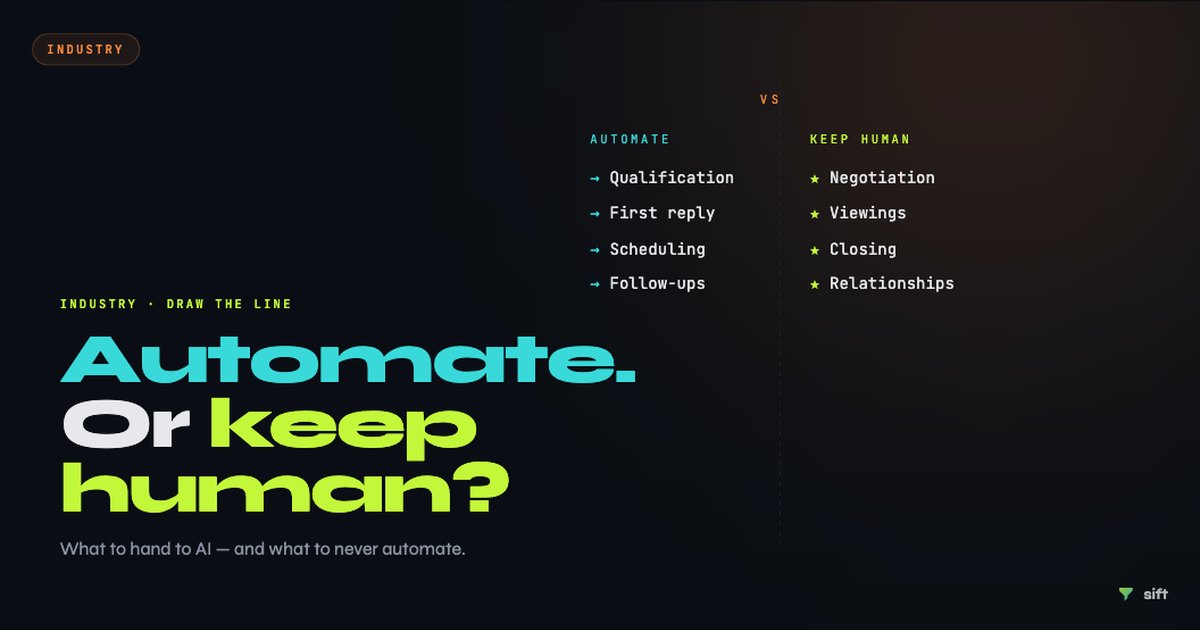
The automation anxiety, and why it's mostly misplaced
Estate agents are right to be sceptical of automation claims. The property industry has been sold many tools that promised to transform workflows and delivered more complexity instead. And there's a genuine fear that goes deeper: if AI can qualify leads, respond to enquiries, and book viewings, what's left for a negotiator to do?
The answer becomes obvious when you think carefully about what estate agency is actually selling. Buyers and vendors aren't transacting on Rightmove, they're navigating one of the biggest financial and emotional decisions of their lives. They need someone who understands their situation, can read a room during a viewing, knows when to push and when to be patient in a negotiation, and can build the trust that keeps a chain together when it gets difficult. That's why tools like AI lead qualification for UK estate agents focus on the administrative layer, not the human one.
No AI does any of that. What AI does well is the other stuff, the predictable, repeatable, time-sensitive work that currently consumes negotiator hours and produces no relationship value. The automation question is about recovering those hours for the work only humans can do.
Automation replaces repetitive execution, not human judgment. A negotiator who spends 45 minutes a day processing and returning portal enquiries is not exercising judgment during those 45 minutes, they're doing data entry with a phone. That time is reclaimable. The 20-minute conversation with a motivated buyer weighing two properties is not reclaimable, it's the actual job.
The automation decision framework
Before automating any task, run it through three questions:
Is it predictable and rule-based?
If the same inputs reliably produce the same correct output, qualify this buyer, send this confirmation, enter this data, it's automatable. If it requires reading context, interpreting tone, or making a judgment call the client would notice, it's human work.
Is it time-sensitive in a way humans can't reliably meet?
Responding to a portal enquiry within 30 minutes, 24/7, is time-sensitive in a way a team of humans cannot reliably meet. Responding to a vendor's concerns about an offer is time-sensitive too, but it requires a human's judgment, not speed alone. Automate the former; prioritise the latter.
Would the client notice, and care, if it were automated?
An instant acknowledgement email after an enquiry doesn't feel robotic, it feels prompt. A condolence message to a buyer who just lost a bid that's clearly auto-generated feels cold. Test the experience from the client's perspective, not the efficiency perspective.
What to automate
These are the tasks where automation delivers measurable gains with minimal client relationship risk:
Where automation delivers the highest ROI
Not all automation is equal. Here's a realistic ranking by impact for a typical independent agency:
| Automation | Time saved / week | Revenue impact | ROI tier |
|---|---|---|---|
| 24/7 buyer qualification (AI chat widget) | 5-10 hrs/week | Captures out-of-hours enquiries that would otherwise be lost | High |
| Automated lead scoring + CRM push | 3-5 hrs/week | Negotiators prioritise highest-value leads first | High |
| Viewing confirmation + reminder sequences | 2-3 hrs/week | Cuts viewing no-shows with automated reminders | High |
| Enquiry acknowledgement emails | 1-2 hrs/week | Reduces buyer drop-off during response gap | Medium |
| Document request automation | 2-4 hrs/week | Speeds up sale agreed to exchange | Medium |
| Automated portal email to CRM sync | 1-3 hrs/week | Reduces data entry errors, no lost leads | Medium |
| Social media scheduling | 1-2 hrs/week | Brand presence; minimal direct lead impact | Low |
The order in which to automate
Most agencies don't need to automate everything at once, and trying to is how automation projects fail. The order matters. Here's what to do first:
Step 1: Automate initial buyer qualification
This is the highest-ROI automation in estate agency, for a simple reason: it happens before anything else, and it happens at a time (nights, weekends, bank holidays) when humans can't do it reliably. A buyer who enquires at 9pm on a Sunday and gets qualified before Monday morning is a fundamentally different lead from one who goes cold over the weekend.
An AI chat widget on your website (like Sift) handles this automatically, capturing chain status, DIP/AIP, budget, and timeline, then scoring the lead and delivering it to the Sift dashboard with full transcript and GDPR consent record. Export leads via CSV on every plan; on Growth and Scale, route them into other systems via Zapier (6,000+ apps), an outbound webhook, or the REST API. Your first call on Monday is informed, not exploratory. See our full guide on AI lead qualification for the detail.
Step 2: Close the CRM data entry gap
Most agencies are still manually copying enquiry data from portal emails into their CRM. This wastes 3-5 hours per week per negotiator, introduces errors, and means there's always a lag between enquiry and first contact. If your CRM has any automation or integration capability, use it to map portal emails to lead records automatically.
Step 3: Build viewing confirmation sequences
Viewing no-shows cost time, fuel, and sometimes a vendor's trust. Automated confirmation emails at booking + 24h reminder + 2h reminder have been shown to reduce no-show rates materially. Most CRMs support this natively, if yours doesn't, a simple tool like Calendly integrated with your CRM workflow achieves the same result.
Step 4: Scoring and prioritisation
Once buyer qualification data is flowing into your CRM (via step 1 or manual intake), configure your CRM to surface the highest-scoring leads at the top of each negotiator's daily queue. A lead score isn't a substitute for judgment, it's a signal for where to start. See our lead scoring framework for how to build this.
The risks of over-automating
Automation done badly is worse than no automation. The risks to watch for:
- Generic responses that feel cold. Auto-responses that reference the wrong property, use the wrong name, or feel like a mass email destroy the first impression. Test every automated touchpoint as if you're the client receiving it.
- Automating away the qualification call. AI can collect signals, but a negotiator who never makes a first qualifying call loses relationship information that doesn't appear in a form. Use AI to inform the call, not replace it entirely.
- GDPR compliance gaps. Any automated tool collecting personal data needs ICO-aligned consent, a clear privacy notice, and a data retention policy. Don't automate your way into a compliance problem. See our AI and GDPR guide.
- Automating what vendors notice. Vendors are high-touch by nature, they're trusting you with their home. Any automated communication that goes to vendors should be carefully reviewed. Buyers tolerate automation better than vendors do.
The whole framework above assumes buyer-facing automation. Vendor-facing automation is different, vendors expect and deserve personal contact at most touchpoints. Automated property alerts, market updates, and viewing summaries are fine. Automated responses to vendor queries about their sale are not.
What this looks like in practice: a typical agency week
With buyer qualification, CRM sync, and viewing reminders automated, a typical week looks different:
- Monday 8:30am: Negotiator opens CRM to find 14 weekend enquiries, all pre-qualified with lead scores. Top 3 are chain-free buyers with AIPs who want to move within 8 weeks. These get called by 9:15am, before competitors have read their email.
- Across the week: No manual copy-paste from portal emails. No chasing buyers for information they've already provided to the AI. Viewings don't get missed because reminders went out automatically.
- Friday afternoon: The negotiator is doing what they're paid to do, speaking with buyers, managing a negotiation, visiting a vendor. Not processing enquiries.
This is the promise of automation done right: not fewer estate agents, but estate agents doing the actual work of estate agency rather than the administrative layer around it.
Start with the highest-ROI automation first
Sift qualifies buyers on your website 24/7, capturing the signals your negotiators need before a first call, at the moment enquiries arrive. From 149 per month, 14-day free trial, no card required.
Start Free Trial